How Long Does Cologne Last on Clothes? Longer Than You Think
Most people learn this the wrong way round — by finding an old shirt that still smells of a fragrance they stopped wearing two years ago.
How long does cologne last on clothes?
| Concentration | On skin | On fabric |
|---|---|---|
| Eau de cologne | 2–3 hours | A day or so |
| Eau de toilette | 3–5 hours | Several days |
| Eau de parfum | 6–8 hours | A week or more |
| Parfum / extrait | 8–12 hours | Weeks, on heavy fabric |
Ranges rather than numbers, because the variables are large: how much you applied, the fabric, how the garment is stored, and how sensitive your own nose is to a scent you have been living inside.
Why does fragrance last longer on fabric than on skin?
Skin is hostile to perfume. It is warm, which accelerates evaporation. It is oily, which changes how the notes read as they develop. It has a pH that interacts with the composition. And it renews itself constantly, taking the fragrance with it.
Fabric is the opposite — an inert, porous surface at room temperature. Fragrance molecules settle into the weave and evaporate at their own natural rate, with nothing accelerating or altering them. The heavier base notes, which are the largest and slowest molecules, effectively get trapped.
This is also why fragrance on clothes smells flatter. On skin a fragrance opens, develops and dries down over hours. On fabric you mostly get the base — the woods, resins and musks — with the bright top notes long gone.
Which fabrics hold scent longest?
Wool, cashmere and heavy cotton hold the most. Dense natural fibres with a lot of surface area give the molecules somewhere to sit. A wool coat is effectively a fragrance archive.
Cotton and linen hold well, though less than wool, and release more evenly.
Polyester and technical synthetics hold fragrance the least usefully. They are non-porous, so scent sits on the surface and fades quickly — but they also trap the odour compounds produced by bacteria, which is the reason a gym top can smell fine in the drawer and awful ten minutes into a session. We covered that in sports detergent and what actually works on gym kit.
Should you spray cologne directly on clothes?
Sparingly, and not on everything. It genuinely makes a fragrance last longer, and it is how a lot of people get all-day projection without over-applying to skin.
Three real cautions. Fragrance is alcohol and oil, and both can stain — silk, satin and pale linen are the risky ones, and darker fragrances stain more visibly. Alcohol can degrade delicate fibres over repeated applications. And on tailoring, spraying the same spot repeatedly will eventually mark it, which is why the inside of a lapel is the traditional target rather than the outside.
The safer version: spray into the air and walk through it, or spray the lining rather than the face of the cloth.
How do you get old cologne smell out of clothes?
An ordinary wash removes most of it. For a fragrance that has genuinely embedded — a jacket you cannot wash, or a shirt that has held a scent through several cycles — the sequence that works is: air it outdoors for a full day first, then wash at 30°C with a detergent that carries its own fragrance rather than a fragrance-free one. If the garment is wool or cashmere, use a dedicated wool wash instead — enzyme detergents degrade protein fibres. Replacing a scent works better than trying to strip it.
Do not use a hot wash to force it. Heat sets some fragrance compounds into the fibre rather than removing them, and it will damage the garment first.
Where your detergent comes into this
Here is the part almost nobody thinks about. Your clothes carry two fragrances at once: whatever you spray, and whatever you wash in. If those two disagree, the result is a muddle — and the one you will smell at four in the afternoon is usually the laundry, because it is in the fabric rather than on it.
The same mechanism that makes cologne last on cloth is the one that makes laundry fragrance last on cloth. Which means the laundry scent is not background noise. It is the base layer of everything you wear, applied every single wash, whether you chose it deliberately or not.
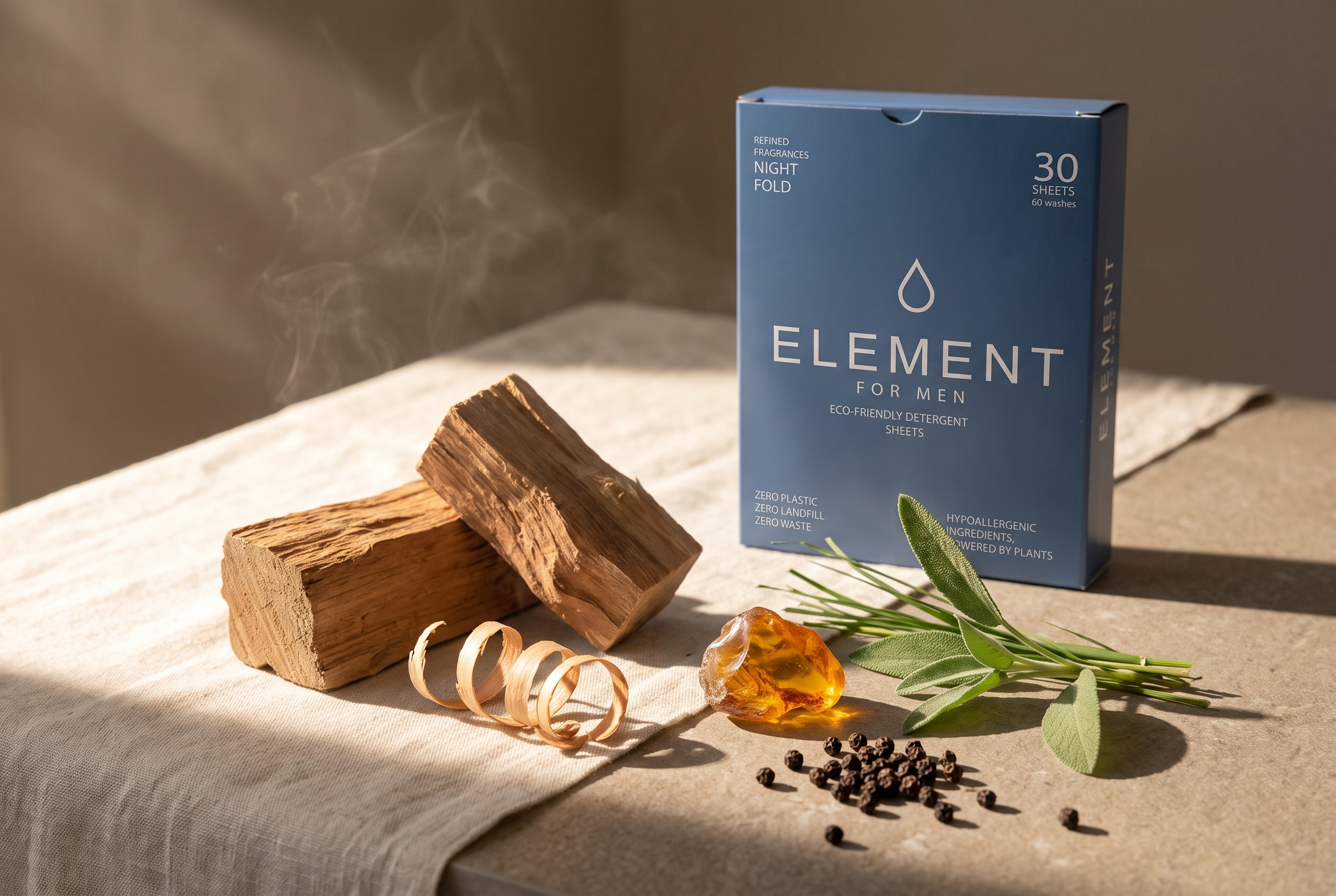
That is the whole reason Element's three scents — Night Fold, Ocean Air and Wild Spice — are built as fragrances rather than as freshener notes, and why the conditioner comes in the same scent: the conditioner is deposited in the final rinse and stays on the fibre, so it does most of the lasting work.
Related reading: why your cologne fades by lunchtime · eau de toilette vs eau de parfum · how long clothes stay smelling fresh.