Skip to content

Cart

Your cart is empty

Ingredients & Transparency

What's actually inside Element

Two products. A short list of things worth naming. Here is every one of them, what it does in the wash, and the ones we deliberately leave out.

  • Dissolves in seconds
  • Works at 30°C
  • No plastic bottle for the sheets
  • Never tested on animals
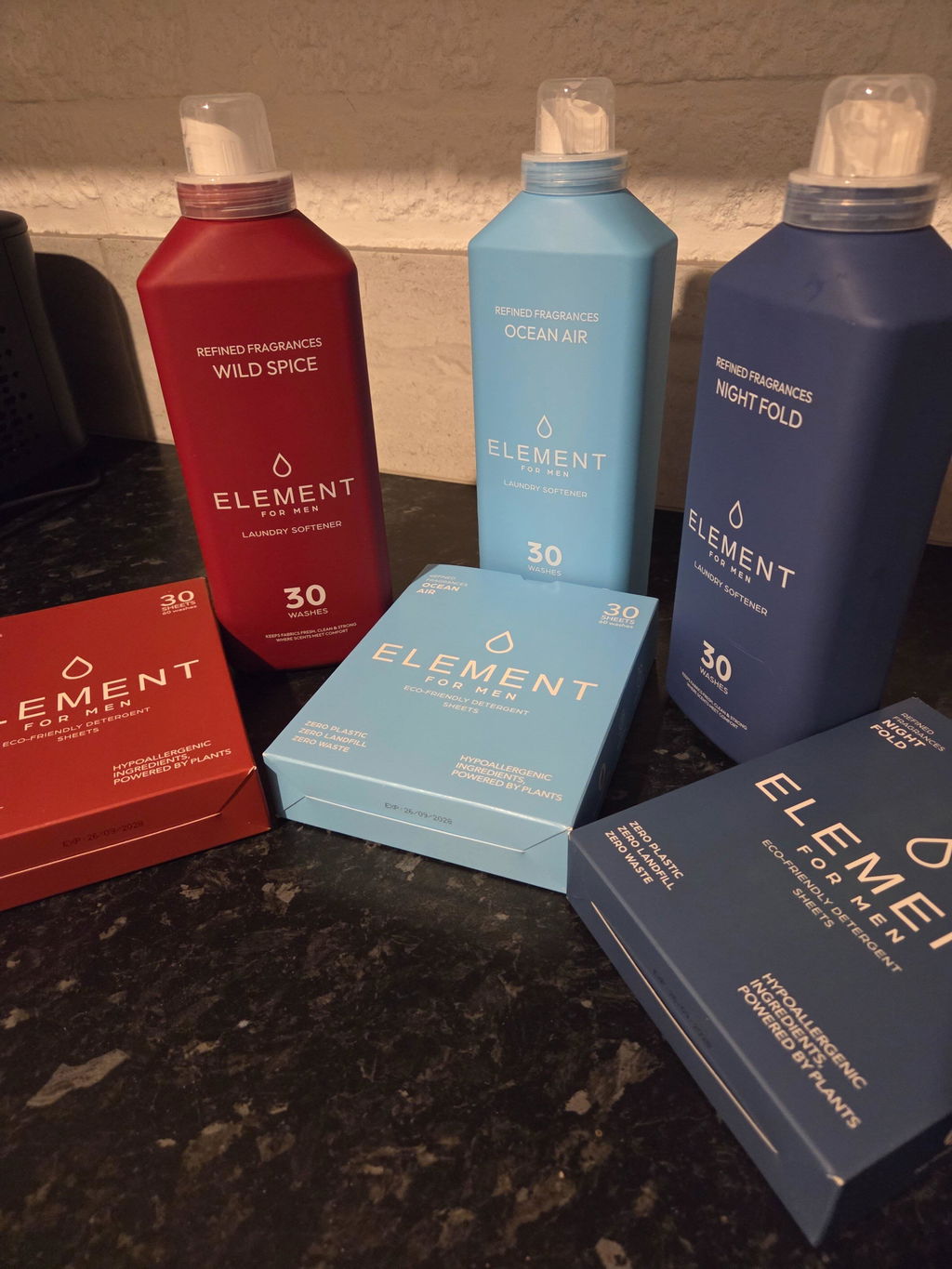
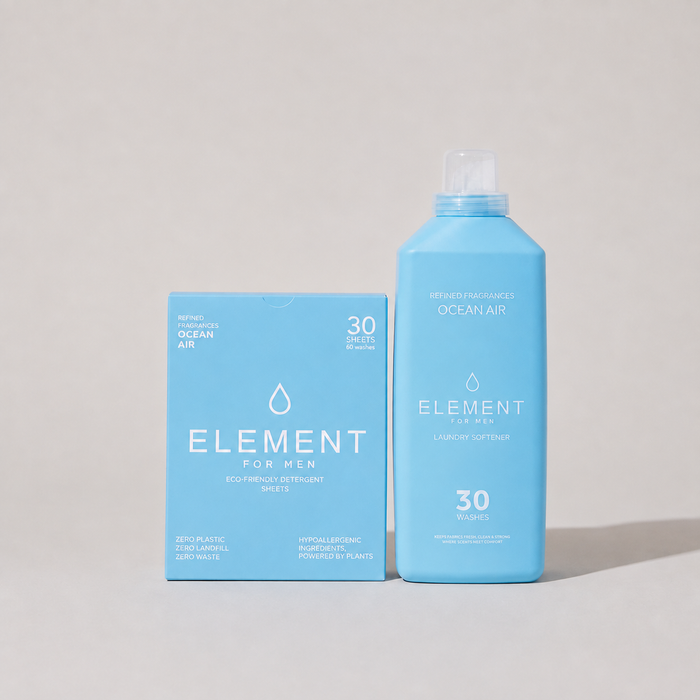
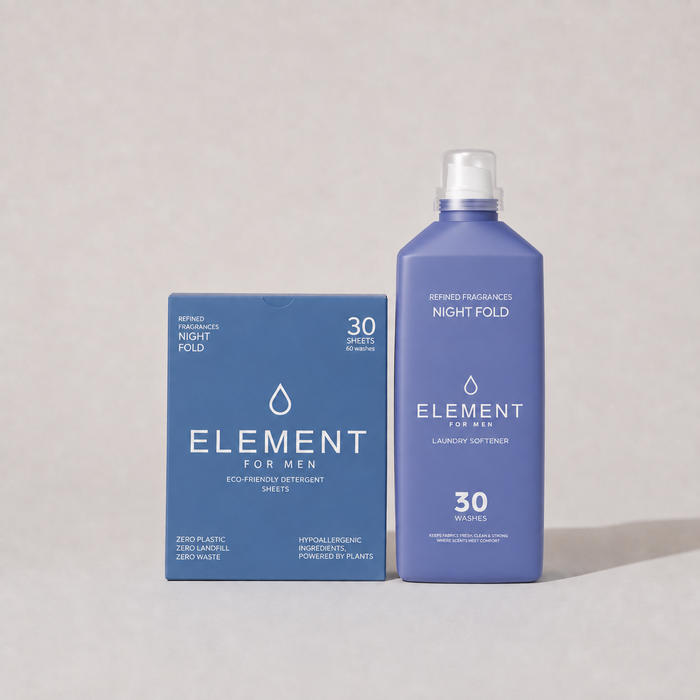
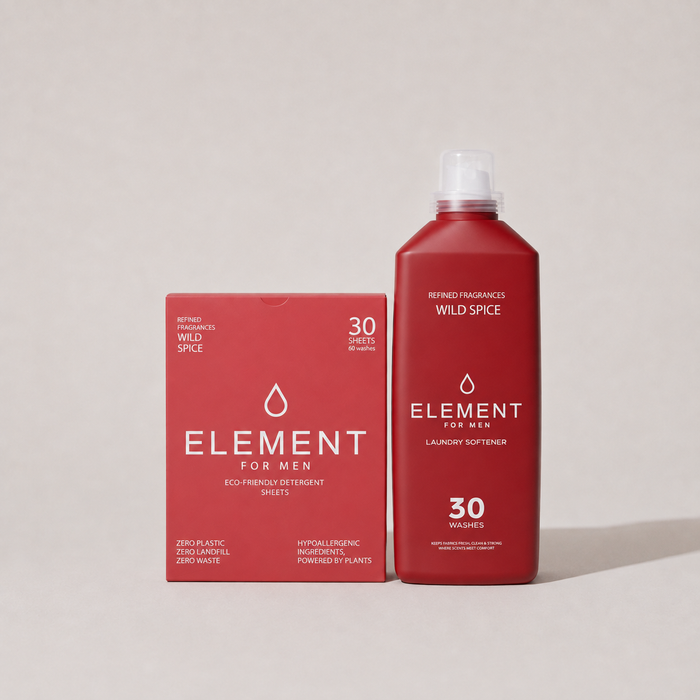
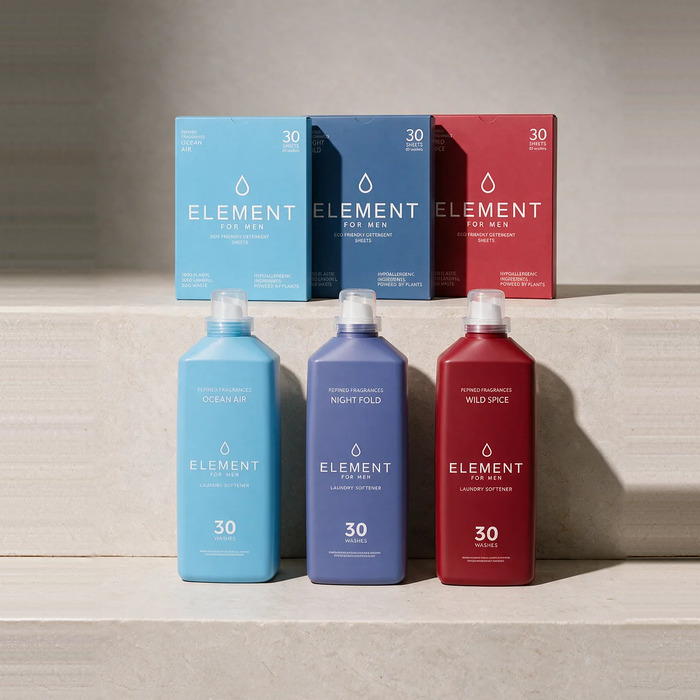
The full Element for Men range — detergent sheets and fabric softener in Ocean Air, Night Fold and Wild Spice

What we put in

Two products. Two different jobs.

One cleans. One conditions the fibre and carries the scent. They're built to the same fragrance, so nothing fights. Everything below is disclosed in line with UK detergent regulations — and then explained, which the regulations don't require.

Element for Men laundry detergent sheets box — 30 sheets in recyclable cardboard

01 — Cleans

Detergent Sheets

A pre-dosed strip of concentrated detergent. It goes straight into the drum, under the clothes, and dissolves in seconds. No bottle, no cap, nothing to measure and nothing to spill down the side of the machine.

  • Anionic surfactants

    The primary cleaner. They grip oil and grime at one end and water at the other, lift it off the fibre and hold it in suspension so it drains away instead of resettling.

  • Non-ionic surfactants

    The greasy-mark specialists. They carry no charge, which means hard water doesn't blunt them — useful across most of the UK.

  • Enzymes

    Targeted at what your body actually puts on clothes — sweat, body oil, food protein. They work at 30°C, which is why you don't need heat to get a proper wash.

  • Polyvinyl alcohol

    The water-soluble film that holds the sheet together and lets it dissolve in seconds. It is what makes a pre-dosed sheet possible at all.

  • Sodium citrate

    A water softener derived from citric acid. It ties up the calcium in hard water so the surfactants spend their energy on your clothes rather than on limescale. It's here instead of phosphates.

  • Fragrance

    Built as a fragrance rather than a cleaning smell — top, heart and base. The full structure of each of the three is further down this page.

  • 30 sheets a box — up to 60 washes if you tear a sheet in half for small loads
  • Dissolves in seconds. Works from 30°C
  • 100% recyclable cardboard. Fits a drawer, posts through a letterbox
  • Free from dyes and phosphates
Element for Men 1 litre fabric softener bottle

02 — Conditions & carries the scent

Fabric Softener

Goes in the ❀ compartment of the drawer, never in the drum. The machine holds it back and releases it in the final rinse, after the detergent has gone. That timing is the entire point — softener needs clean fabric to land on.

  • Cationic surfactants — under 5%

    The softening agents. They carry a positive charge, fabric in the rinse carries a negative one, so they lie down along the fibre and coat it. That's what "soft" physically is: fibres lying flat instead of standing on end. It's also what kills static and makes ironing quicker.

  • Fragrance microcapsules

    Fragrance held in tiny reservoirs that bind to the fabric during the rinse and release gradually through the day as the cloth moves against you. It's the mechanism behind scent that's still there at five o'clock rather than gone by lunchtime.

  • 1 litre — 30 washes
  • Matched to the sheet, scent for scent, so the fragrance is consistent front to back
  • Free from dyes and phosphates
  • Works across shirts, bedding, denim, knitwear, towels and everyday synthetics

In the machine

Three things, and most people get one of them wrong.

01

Sheet in the drum. Not the drawer.

Put it in first, then the clothes on top, so it's in the water from the moment the cycle starts. A sheet in the drawer is a sheet stuck to the drawer.

02

Softener in the ❀ compartment.

Three compartments: II is main wash, I is pre-wash and you'll almost never use it, and the one with the flower is softener. Fill to the max line, never past it.

03

30°C is enough.

The enzymes are built for it. Save the hot cycles for bedding and towels, where you're washing for hygiene rather than for cleaning power.

About the fragrance

Built like a fragrance. Then put where you actually wear it.

Most detergent smells extraordinary in the box and of nothing by lunchtime. That isn't a con, it's chemistry — what you smell in the shop is top notes, and top notes evaporate in about an hour. What survives to the end of the day is the base. So all three of ours are composed the way a fragrance is composed, with the interesting work happening at the bottom of the pyramid rather than the top.

Ocean Air fragrance ingredients — bergamot, sea salt and driftwood arranged around the Ocean Air fabric softener bottle

Ocean Air

The early start. The least complicated of the three, and that is precisely the point — it reads clean before it reads as anything else. The scent nobody can name and everybody notices.

  • TopBergamot
  • HeartSea salt
  • BaseDriftwood

Shop Ocean Air

Night Fold fragrance ingredients — pineapple, blackcurrant, birch and oakmoss arranged around the Night Fold fabric softener bottle

Night Fold

The quiet authority. Fruit on top, smoke and moss underneath, built like the after-dark bottles on the shelf. The woods sit in the base, which is why it's still on the shirt on Thursday.

  • TopPineapple · Blackcurrant
  • HeartBirch
  • BaseOakmoss

Shop Night Fold

Wild Spice fragrance ingredients — cardamom, black peppercorns, sandalwood and leather arranged around the Wild Spice fabric softener bottle

Wild Spice

The one they remember. Spice projects further than almost anything else in fragrance, which is why this is the one that gets asked about. It sits in the base, so it's still there hours after you left the house.

  • TopCardamom
  • HeartBlack pepper
  • BaseSandalwood · Leather

Shop Wild Spice

How to judge it properly

Don't smell the bottle. Wash a shirt, dry it fully, then smell it eight hours later. The gap between what a detergent smells like wet and what it smells like at the end of a day tells you everything about how it was built.

What we leave out

Six things you won't find, and why.

Phosphates

Cheap, effective water softeners with a long history of causing algal blooms in rivers. Sodium citrate does the same job in our formula.

Dyes

Colour in a detergent exists to make the product look like something. It contributes nothing to the wash. Ours are white.

Chlorine bleach

Ruthless on stains and ruthless on everything else — colour, elastane, fibre strength. Not something we'd put in a product you use on every load.

Optical brighteners

They don't clean anything. They deposit a compound on the fabric that fluoresces under daylight so white appears whiter. It's a visual trick, and it stays on the cloth.

Animal-derived ingredients

None, in either product.

Animal testing

Never. Not by us, not on our behalf. Ever.

Fragrance standards

Made to the same benchmark as the perfume industry.

Our scents are developed with professional fragrance houses to International Fragrance Association (IFRA) standards for household products — the framework the perfume industry works to.

Like fine perfume and natural essential oils, fragrance can contain naturally occurring allergens. We're not going to pretend otherwise, and we don't make claims about skin. If you have a known fragrance sensitivity, email us and we'll send the specific allergen list for any scent, same day.

contact@elementformen.com

Questions

The ones we actually get asked.

What are Element detergent sheets made of?

Anionic and non-ionic surfactants, enzymes, polyvinyl alcohol, sodium citrate and fragrance. That's the whole list. The surfactants do the cleaning, the enzymes handle sweat and body oil at 30°C, the polyvinyl alcohol is the soluble film that holds the sheet together, and the sodium citrate softens hard water so the surfactants aren't wasted on limescale.

Do Element sheets contain microplastics?

The sheet contains polyvinyl alcohol, a water-soluble polymer, at roughly 15–20% by weight. The fabric softener uses fragrance microcapsules. Whether either should be classified as a microplastic is contested — the current EU definition of synthetic polymer microparticles excludes soluble polymers, but the science and the regulation are both still moving.

So we don't make a "microplastic-free" claim, and we don't make a "plastic-free" claim about the sheet. We publish the ingredients instead. The full explainer is here.

Is Element bio or non-bio?

Bio. The sheets contain enzymes, and that is the only real difference between bio and non-bio — everything else on a supermarket box is marketing.

One honest caveat: enzymes break down protein, and wool and silk are protein. Use a dedicated wool wash on those. Everything else — cotton, linen, synthetics, gym kit, bedding — is what this is built for.

Where does the sheet go — the drum or the drawer?

The drum, always. Put the sheet in first, then the clothes on top. A sheet in the drawer will stick to the drawer instead of dissolving in the wash.

Fabric softener is the opposite: it goes in the drawer, in the compartment marked with a flower, filled to the max line and no further.

How many washes do I get?

Thirty sheets to a box, and up to 60 washes if you tear a sheet in half for smaller loads. The 1 litre fabric softener is 30 washes at the standard dose.

Is it suitable for sensitive skin?

We don't make skin claims, and we'd be suspicious of any fragranced laundry product that does. Fragrance — including natural essential oils — can contain declarable allergens, and ours are no exception.

If you have a known fragrance sensitivity, email us before you buy and we'll send the specific allergen list for the scent you're considering.

Do you test on animals?

No. Never, and never on our behalf. There are also no animal-derived ingredients in either product.

Can I get the complete ingredient breakdown for a specific product?

Yes. Email contact@elementformen.com naming the product and the scent, and we'll send the full disclosure and allergen list over.

Origin

Where Element is made

Ingredients are only half of transparency. The other half is who makes it, and where.

Brand and company
Element Essentials Men Limited, registered in England and Wales, company number 16282325. Founded 2025. British owned and British run.
Formulas, packaging and standards
Specified and signed off in the UK. Nothing is handed to a factory to interpret.
Manufacturing
2 specialist partners in China, who make detergent sheets and fabric softeners for a living, producing to our formulas, our fragrance briefs and our quality standard.
Fragrance development
International perfumers, formulated in line with IFRA — the standards the fine fragrance houses work to. Naturally occurring allergens are declared.
Animal testing
Never, at any stage. No animal-derived ingredients.
Shipping
The United Kingdom only, for now.

We chose those partners on capability rather than postcode. Buying direct from them, with no supermarket or distributor in between, is why a product built to fine fragrance standards does not carry a fine fragrance price.

The longer version, including who built this and why: our story.