Are Laundry Detergent Sheets Worth It? An Honest Verdict
Written by a brand that sells sheets, which is exactly why the paragraph above names the people who should not buy them.
- Sheets are worth it if you mostly wash at 30°C, mix load sizes and want rid of plastic bottles — a sheet tears in half for a part load.
- They are not the pick for heavily soiled workwear, routine 40°C-plus washing, or buying on lowest unit price, where own-brand liquid and pods win.
- On everyday 30°C laundry they clean as well as liquid, and using two sheets closes the gap on heavier soiling.
What do you actually gain?
Dose control. The most underrated one. A sheet tears in half, so a small load costs half a dose. A pod cannot be halved and liquid gets over-poured by almost everyone — the standard cap is larger than most washes need. Over-dosing is one of the most common causes of clothes not smelling clean, because the excess never rinses out.
No measuring, no drips, no sticky cap. Small, but it is the thing people mention unprompted after switching.
Storage and weight. A box of thirty sheets is the size of a paperback and weighs almost nothing. It fits in a drawer, posts through a letterbox and does not need carrying home.
No plastic bottle. Liquid detergent is largely water in a plastic jug, shipped by road. A dry sheet in 100% recyclable cardboard removes both the jug and most of the weight shipped.
What do you give up?
Raw power on heavy soiling. A single sheet carries less active ingredient than a multi-chamber pod. Two sheets closes most of the gap, but if your laundry is genuinely dirty rather than worn — trade work, mud, oil — pods are engineered for that and sheets are not.
Price per wash at the bottom of the market. Supermarket own-brand liquid is cheap and effective, and no premium sheet competes with it on cost. If price is the deciding factor, this is not a close call.
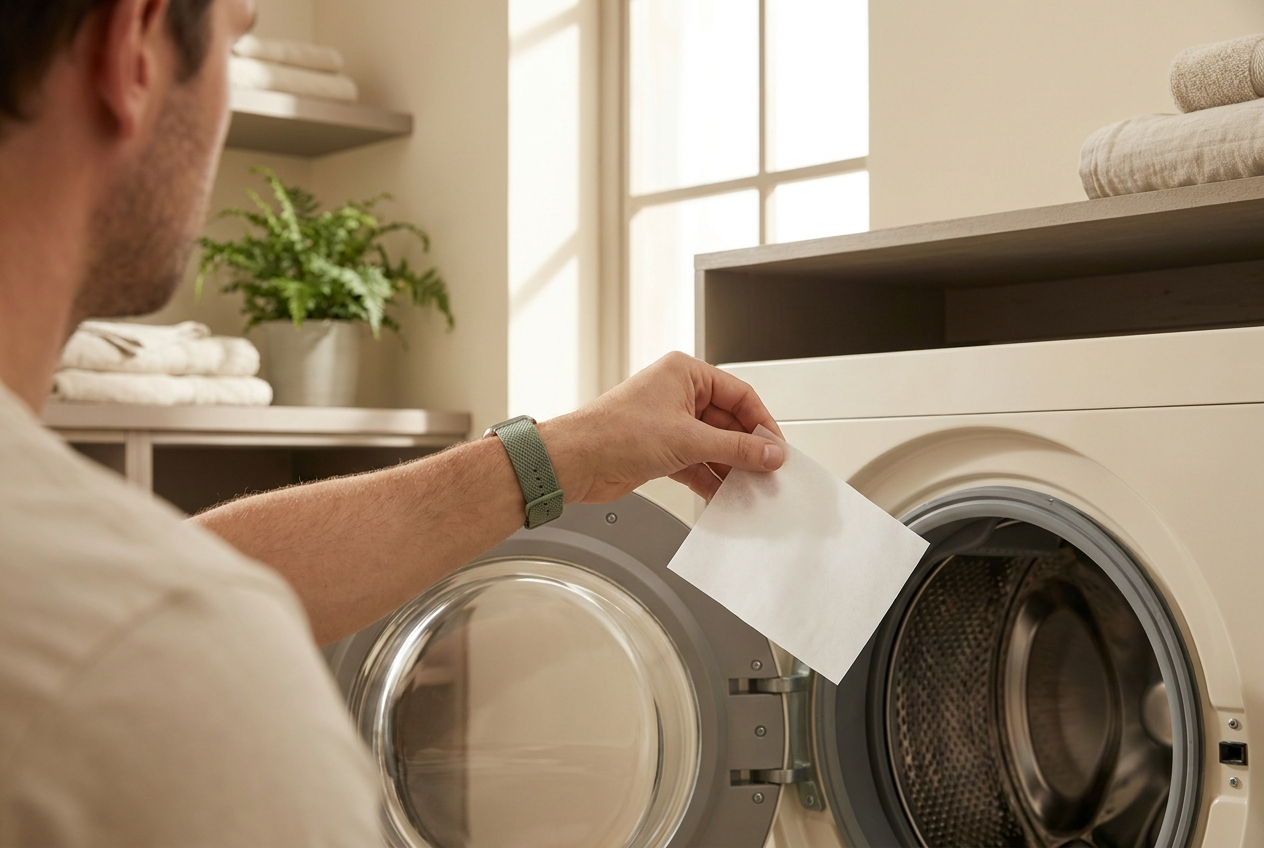
Undissolved sheets in specific conditions. Sheets can fail to dissolve fully in very cold water, in an overloaded drum, or when placed on top of a packed load rather than at the bottom. Put the sheet in the empty drum first, then the clothes, and the problem disappears.
Fewer specialist variants. The sheet market is thinner on colour-protect and non-bio options than the liquid aisle. That is improving, but it is currently true.
Do detergent sheets clean as well as liquid?
On ordinary laundry washed at 30°C — shirts, t-shirts, jeans, bedding, anything worn rather than soiled — yes. The active ingredients are the same class of chemistry; the difference is that one arrives dry and the other arrives dissolved in water you paid to ship.
On heavy soiling and higher temperatures, a concentrated liquid or a multi-chamber pod has more in it. That is a dose difference, not a quality difference, and it is largely closed by using two sheets.
So who should switch?
| Worth it | Not worth it |
|---|---|
| You wash at 30°C | You wash heavily soiled workwear |
| You mix small and large loads | You wash at 40°C+ as standard |
| Storage is tight, or you carry your shopping | Lowest unit price is the deciding factor |
| You want the plastic bottle gone | You need a specific specialist variant |
| You care what your clothes smell like all day | You are happy with what you use |
If you do switch, what should you look for?
Three things. Does it publish its ingredients in full — or does it talk around them. Is the scent something you would wear — this is the axis where sheet brands differ most and where most of them are indistinguishable. And is there a matching conditioner, because detergent is rinsed out during the wash while conditioner is deposited in the final rinse, which is what makes fragrance last past lunchtime.
Element makes detergent sheets in three scents — Night Fold, Ocean Air, Wild Spice — 30 sheets for £7.99, up to 60 washes if you split them, with a matching 1L conditioner in each. If you want to test the pairing rather than the sheet alone, the bundle is £14.99.
Related reading: laundry sheets vs pods · every format compared.
Common questions
Are laundry detergent sheets worth it?
For most households, yes. They are worth it if you wash mostly at 30C, run a mix of load sizes, and want to stop storing plastic bottles, because a sheet can be torn for a half dose and a box weighs almost nothing. They are not worth it if you regularly wash heavily soiled workwear, wash at 40C or above, or buy on lowest unit price, where supermarket own-brand liquid and pods win.
Do laundry sheets clean as well as liquid detergent?
On ordinary laundry washed at 30C, yes. The active ingredients are the same class of chemistry, delivered dry rather than dissolved in water. On heavily soiled laundry and higher temperatures a concentrated liquid or multi-chamber pod carries more active ingredient per dose, though using two sheets largely closes that gap.
Why did my laundry sheet not dissolve?
Usually one of three causes: water that is too cold, an overloaded drum, or the sheet placed on top of a packed load rather than underneath it. Put the sheet into the empty drum first and then load the clothes on top, and it will dissolve reliably.
Are laundry sheets cheaper than liquid?
Not against supermarket own-brand liquid, which is the cheapest option in the category and no premium sheet matches it. Against branded liquid and premium pods, sheets are comparable, and they can work out cheaper in practice for households that run part loads, because a sheet can be torn in half while a pod or a capful cannot.