Why 'More Detergent' Is the Most Expensive Laundry Myth
Most men work out how much detergent to use the way they pour a whisky — by eye, and generously. More must mean cleaner.
It doesn't. It means a bigger bill and flatter-smelling clothes. Here's the maths, the residue, and the amount you should actually use.
The short version
- Past a point, extra detergent can't dissolve — it stays in your clothes.
- That residue stiffens fabric, traps damp and feeds the bacteria behind stale smells.
- One measured dose per load is the fix. A pre-measured sheet removes the guesswork entirely.
Does more detergent clean better?
A washing machine only holds so much water. Detergent works by dissolving into that water, lifting dirt, then rinsing away. There's a ceiling: once the water is saturated, extra detergent has nowhere to go and nothing to do.
It doesn't clean harder. It just doesn't leave. A normal load needs one dose. Doubling it doesn't double the cleaning — it doubles the leftovers.
What does too much detergent do to clothes?
Here's the part that stings. Excess detergent doesn't vanish in the rinse. It settles into the fibres and the folds — along waistbands and cuffs, where fabric bunches.
That residue does three unhelpful things. It dulls colour and stiffens fabric. It holds damp. And damp plus leftover detergent is exactly what odour-causing bacteria feed on. So the load you over-dosed to make fresher comes out faster to turn stale.
Watch: Stiff towels or gym kit that smells the moment it's damp? Over-dosing is a prime suspect — not under-washing.
How much does over-dosing detergent cost?
Run the numbers. Say a wash costs you about 20p of detergent when dosed correctly. Pour “a bit extra” every load — call it 60% more — and you're spending closer to 32p a wash.
Over a year of everyday washing (roughly 260 loads for a busy household) that habit quietly burns an extra £30 or so — for clothes that come out worse. You're paying a premium to make your wardrobe smell of nothing.
| One measured dose | Heavy pour | |
|---|---|---|
| Cost per wash | ~20p | ~32p |
| Cleaning | Full | No better |
| Residue left | Minimal | High |
| Scent life | Longer | Fades flat |
Did you know? The dosing lines on a cap aren't a suggestion — they're calibrated to water hardness and load size. In hard-water areas you may genuinely need the higher line; in soft-water areas the lowest usually over-cleans. Most of the UK sits in between, which is why eyeballing it almost always means too much.
How much detergent should you use?
The honest answer: less than you think, and the same amount every time. If you want the mechanics of a low-residue wash, our how it works page walks through it.
- 1Match the dose to the load, not your mood. One normal load, one measured dose.
- 2Only bump it up for genuinely heavy soil or hard water — not “just in case”.
- 3If clothes come out stiff or filmy, you're using too much. Drop down a level.
- 4Skip the “for luck” extra splash. It's the most expensive splash in the house.
Do this: Still chasing freshness? The other half of the answer is in why your clothes don't smell fresh after washing.
The quiet upgrade
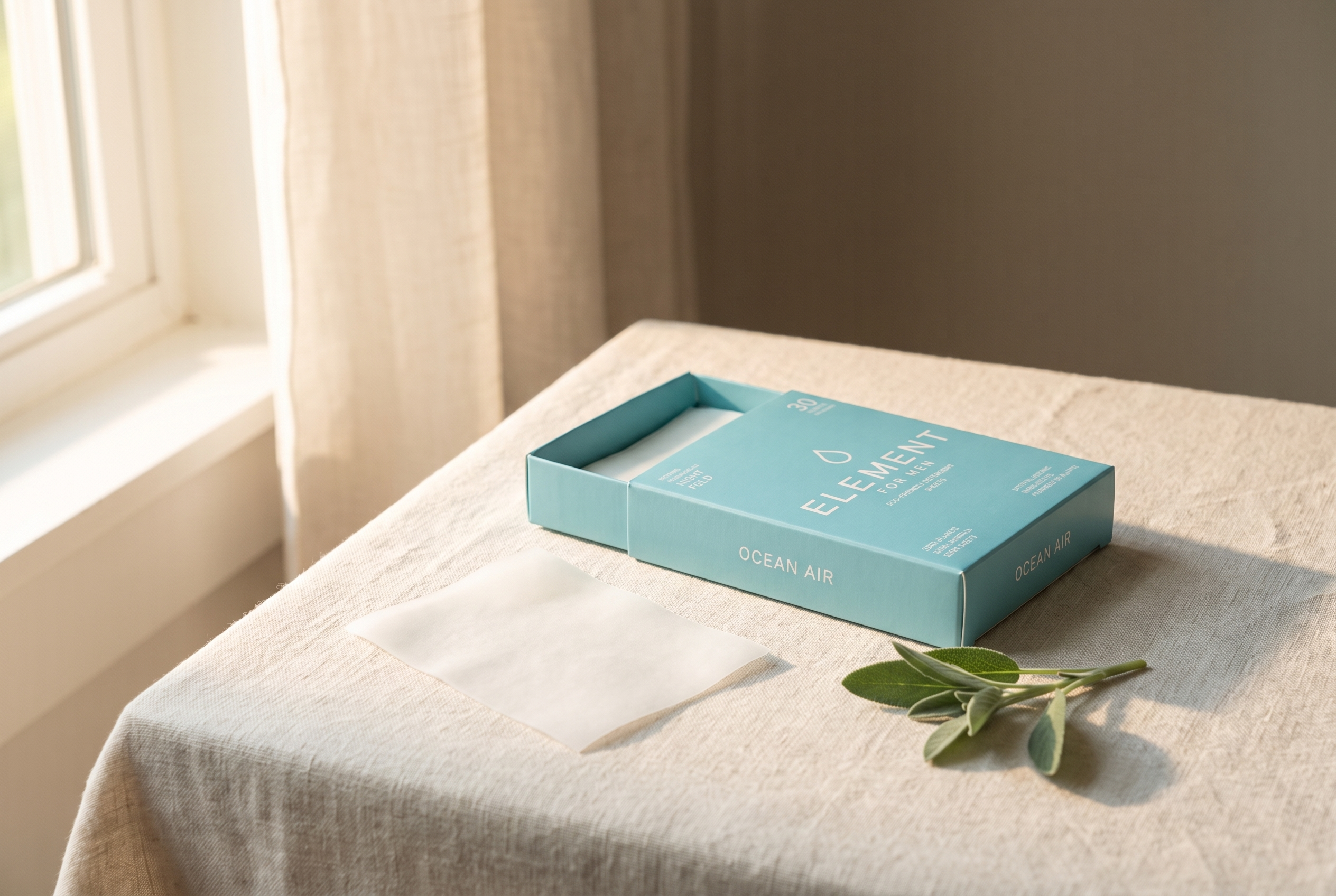
This is where a pre-measured format earns its place. An Element detergent sheet is one wash, one sheet — the dose is decided for you, so there's nothing to over-pour and far less to leave behind. Clothes rinse cleaner, and the scent has room to actually land.
Because the scent is built like a fragrance, “fresh” means smelling like you at 5pm — not a wall of air-freshener at 9am. Ocean Air keeps it crisp and clean; Night Fold is the more refined, understated end. Either way, one sheet, done.
Common questions
How much laundry detergent should I actually use?
One measured dose per normal load — the amount marked for your load size and water hardness. More doesn't clean better; the excess just stays in the fabric as residue.
Is it bad to use too much detergent?
Yes. Excess detergent stays in the fibres, stiffens fabric, traps damp and feeds the bacteria that cause stale smells — so clothes can come out looking duller and turning stale faster.
Do detergent sheets stop me over-dosing?
They pre-measure it: one sheet per load. There's nothing to over-pour and far less residue left behind, which is why clothes rinse cleaner and hold their scent longer.