How to Wash Trainers in the Washing Machine (Without Wrecking Them)
Trainers get worn more than any other thing in a man's wardrobe and cleaned less than any other thing in it. The reason is usually a vague fear that the washing machine will destroy them. Sometimes it will. Mostly it won't, if you know which pair you're holding.
First: can this pair actually go in?
| Material | Machine? | Why |
|---|---|---|
| Canvas | Yes | Handles water well. Expect slight softening — that is the material, not damage. |
| Mesh / knit runners | Yes | Designed to get wet with sweat. Use a mesh bag so the upper doesn't snag. |
| Synthetic uppers | Yes | Cold wash only — heat is what loosens the sole adhesive. |
| Leather | No | Water strips the natural oils. It dries stiff, then it cracks. Wipe clean by hand. |
| Suede / nubuck | No | The nap mats permanently. Brush and use a suede eraser instead. |
| Vintage or reglued pairs | No | Old adhesive plus water plus tumbling is how soles come off. |
| Anything with LEDs or removable tech | No | Obvious once stated, easy to forget at 11pm. |
The six-step method
1. Strip them. Laces out, insoles out. Both hold the majority of the smell, and both clean better separately. Laces go in a small mesh bag or a pillowcase knotted shut. Insoles get washed by hand — machine washing tends to warp the foam.
2. Knock the loose dirt off. Bang the soles together outside, then run a dry brush over the upper and pick grit out of the tread. Mud that goes into the machine wet becomes mud that goes into your next wash.
3. Pre-treat the marks. A little detergent worked into scuffs with an old toothbrush, five minutes before they go in. This is the step that does most of the visible work — the machine is mainly there to rinse.
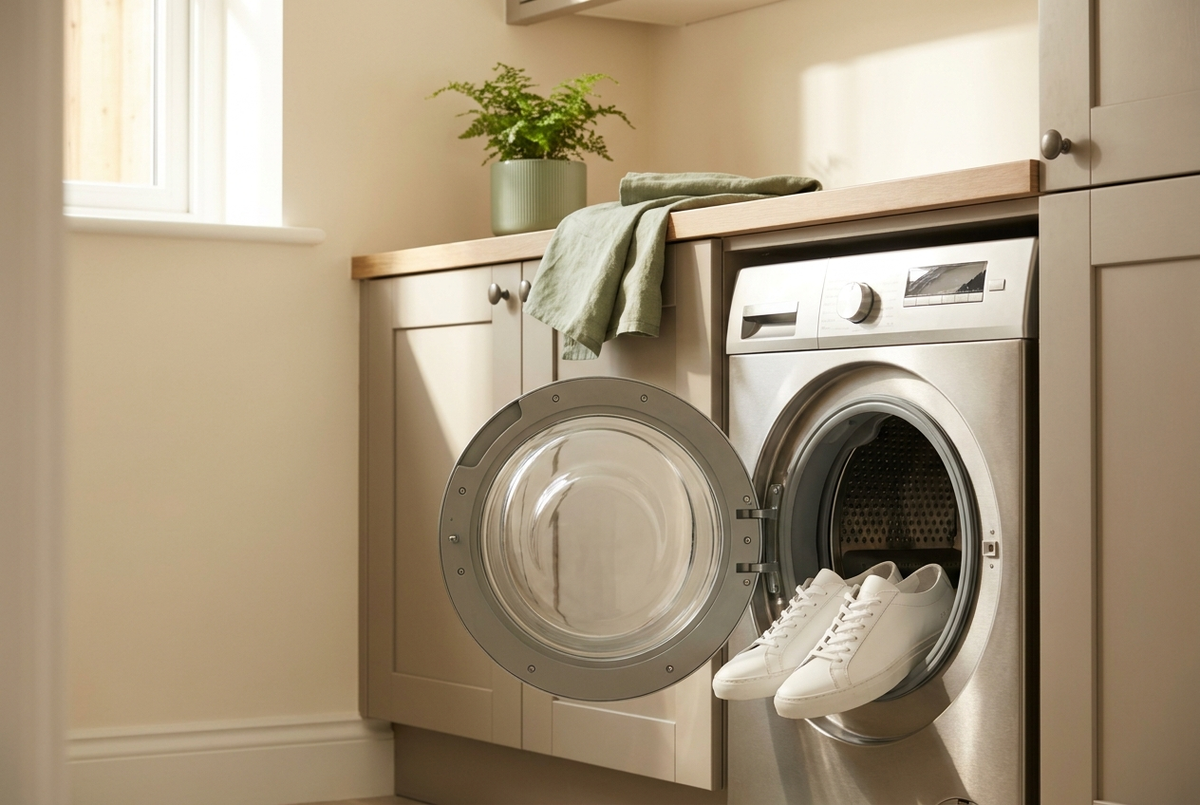
4. Bag them and pad the drum. Trainers into a mesh laundry bag or a pillowcase. Add two or three old towels to the drum. The towels cushion the tumbling, stop the shoes hammering the drum, and cut the noise dramatically.
5. Set the machine properly. Cold or 30°C. Delicate or gentle cycle. Lowest spin your machine offers — high-speed spinning is what deforms the shape. Detergent only. No fabric softener, no bleach.
6. Air dry, patiently. Stuff each shoe loosely with paper or a clean cloth to hold the shape and pull moisture out. Leave them somewhere with air movement, out of direct sun and well away from a radiator. Give it 24 hours. Change the paper once if they were soaked.
Never the tumble dryer
Heat is the enemy of a trainer. It softens the adhesive holding the sole to the upper, and it shrinks synthetic materials unevenly. A tumble dryer applies heat and violent tumbling at the same time, which is the exact combination that separates soles. Radiators are the same problem more slowly.
If you need them faster: a fan pointed at them, paper changed every few hours, and the insoles drying separately.
Why no fabric softener on trainers
Softener works by depositing a thin conditioning layer on fibres. On a cotton shirt that is exactly what you want. On the mesh of a running shoe it sits in the weave and interferes with breathability — the thing the mesh exists for. Save the softener for the wardrobe and keep it away from technical uppers. The same logic applies to gym kit and sportswear.
The smell, specifically
Trainer odour is not really dirt. It is bacteria feeding on the sweat and skin oils absorbed into the insole and lining. Which is why a wash that ignores the insole rarely fixes it, and why the smell returns within a week.
Work through it in order: wash the insoles by hand and dry them completely — damp foam is the whole problem. Let the shoes dry through properly rather than to touch-dry. Rotate pairs so each gets a full day to dry out between wears. And where possible, wear socks with some natural fibre content; pure synthetic socks hold odour harder.
Between washes
Trainers should not need a machine wash more than a few times a year. A dry brush after muddy wear, a wipe on the midsole with a damp cloth, insoles out overnight after a hot day, and rotating between two pairs will keep a pair looking right for far longer than repeated washing will.
The general principle of wardrobe care applies here as it does to everything else: the small maintenance done regularly beats the deep clean done desperately. Same reason linen rewards being washed properly and why a considered laundry routine quietly outperforms an intense one.
What we'd wash them with
Any decent detergent will do the job on a cold delicate cycle — this is not a load that needs anything specialist. If you use detergent sheets, half a sheet is plenty for a bagged pair of trainers with towels. Ours come in three scents — Night Fold, Ocean Air and Wild Spice — and Ocean Air is the one most people reach for on kit and trainers.