Bed Linen and Towels: Temperature, Dosing and Why Towels Go Stiff
Household linen is the load most people get wrong in the same 2 ways: not hot enough for the job, and far too much product for the fabric. Towels tell you about both, because they go stiff long before sheets complain.
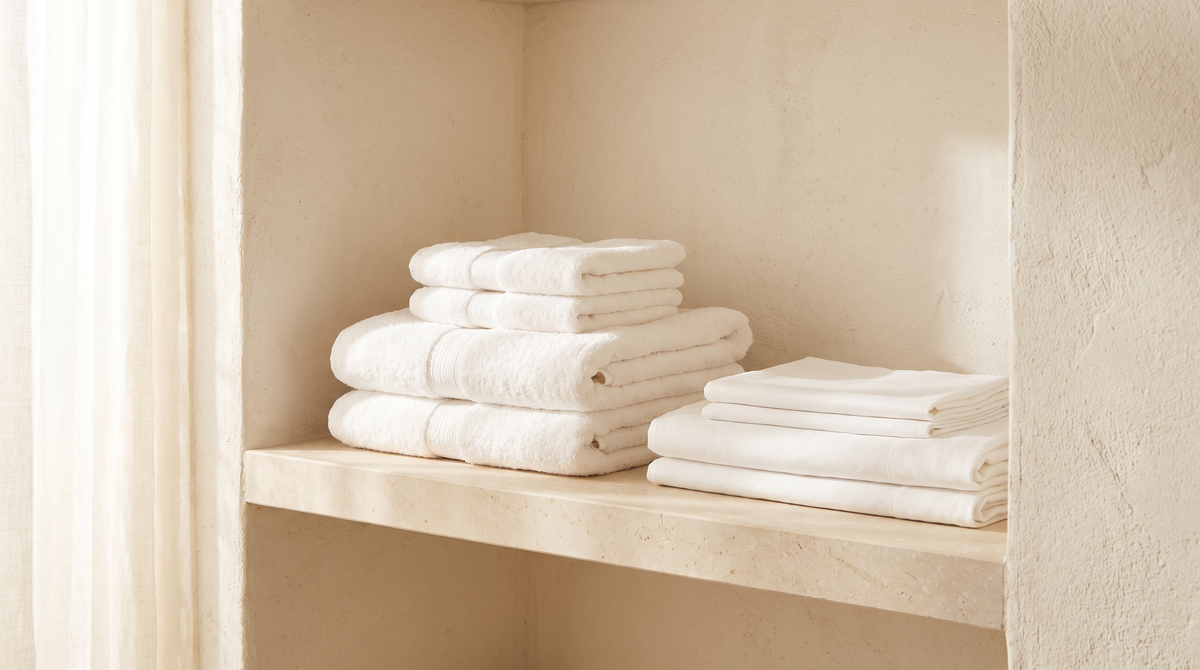
Wash sheets weekly at 40°C to 60°C and towels at 40°C to 60°C with less product than feels right. Towels go stiff from detergent and softener residue plus hard water, not from the wash itself.
How often, and at what temperature
How often should you wash bed sheets?
Weekly for sheets and pillowcases. A bed collects skin cells, body oil and moisture every night, and a week is roughly the point at which that load becomes visible in how the sheets smell on a warm evening. Duvet covers can run to 2 weeks. Pillowcases, which sit against your face, benefit from more often rather than less.
What temperature should bed linen be washed at?
40°C handles ordinary weekly laundry. 60°C is worth using periodically, and after illness, because higher temperatures shift body oils that a cool wash leaves behind — and body oil left in cotton is what makes older linen feel greasy and hold odour. Check the label first: many printed and dyed sets are 40°C maximum.
How often should you wash towels?
Every 3 to 4 uses, and sooner if they never fully dry between them. A towel spends its life damp, which is the condition odour needs. Hanging a towel spread out rather than folded over a rail does more for it than any product.
Why towels go stiff and stop absorbing
A new towel absorbs because the loops of cotton pile are open and uncoated. Everything that goes wrong with a towel is something coating those loops.
Why do towels go hard and scratchy?
| Cause | What it does | Fix |
|---|---|---|
| Too much detergent | Residue the rinse cannot remove stiffens the pile | Dose correctly; run an extra rinse |
| Fabric softener build-up | Coats the loops and repels water | Use sparingly on towels, or skip it |
| Hard water | Mineral deposits inside the fibre | A water softener in the wash |
| Over-drying | Bakes the pile flat and brittle | Remove while very slightly damp |
Swipe to see the full table
Does fabric softener ruin towels?
Used every wash, it works against them. Softener works by leaving a thin conditioning layer on the fibre, and on a towel that layer is exactly what stops water being pulled into the pile. We sell fabric softener and we will still say it plainly: use it on towels occasionally rather than routinely, and keep it for the loads where feel matters more than absorbency.
Does more detergent make linen cleaner?
No. Past the correct dose the extra product has no soil left to attach to, so it stays in the fabric. In a dense towel pile there is a great deal of surface for it to stay on, which is why towels show over-dosing first and sheets show it later.
Loading and drying
How full should the machine be?
Around 3 quarters, with a hand's width of space at the top. Towels and bedding absorb enormous amounts of water and expand, and an over-packed drum cannot tumble — which means neither the wash nor the rinse works properly. A single fitted sheet can also wrap around the whole load and hide everything else from the water.
Should towels be tumble dried?
A short tumble genuinely helps, because the movement lifts the pile that line drying flattens. Take them out slightly damp and finish them on a rail. Drying a towel to bone-dry heat is what makes it feel like cardboard.
A towel does not wear out. It gets coated.
Rescuing linen that has gone wrong
How do you strip build-up out of towels?
- Wash them at 60°C with no detergent and no softener at all.
- Add an extra rinse.
- Repeat once if they still feel coated.
- Return to normal washing with a correct dose.
What about wool blankets and silk pillowcases?
Different rules entirely. Wool, silk and cashmere are protein fibres and no biological detergent belongs on them — use a dedicated wool wash, cool, with minimal agitation. That includes wool throws, silk pillowcases and cashmere blankets, whatever the rest of the bedding is doing.
Household linen is where dosing accuracy shows up fastest, and it is the reason we sell a sheet rather than a bottle. 1 sheet, 1 load — there is no cap to over-fill and no glug to misjudge, so the residue that stiffens a towel pile has nothing to come from.
The sheet goes in the empty drum before the linen, never the drawer. Softener goes in the ❀ compartment — and on towels, use it sparingly rather than every wash.
Element sheets are biological, which is what handles body oil in bedding at moderate temperatures. The exception stands: wool, silk and cashmere need a dedicated wool wash.
See the bundlesKeep reading
Written and fact-checked by the Element for Men editorial team. General guidance only — always follow the care label on the garment.