Ink, Dye and Cosmetic Stains
The category where the wrong first move spreads the problem rather than solving it. Ink and cosmetics are carried in solvents and waxes, and they need dissolving before they can be washed.
Place the mark face-down on a clean absorbent cloth, apply a solvent to the back so the stain transfers out into the cloth, then wash with detergent. Never rub a fresh ink or cosmetic stain — rubbing spreads the pigment across more fibres.
Why this category is different
What holds ink and cosmetics onto fabric?
Not water, and usually not oil alone. Ballpoint ink is pigment suspended in an oily, glycol-based paste. Fountain-pen ink is dye in water with binders. Lipstick and foundation are pigment held in wax and oil. In each case a carrier has to be broken down before the pigment can be removed, and water on its own breaks none of them.
The method, by stain
How do you remove ballpoint pen ink?
- Lay the garment stain-side down on several sheets of clean kitchen paper or a white cloth.
- Dab surgical spirit or isopropyl alcohol onto the back of the stain with a cotton bud.
- Let the ink transfer into the paper below. Move to a clean section as it colours, and keep going until no more transfers.
- Rinse the treated area with cool water to remove the solvent.
- Work detergent in and wash at the temperature the care label allows. Check dry.
How do you remove fountain-pen ink?
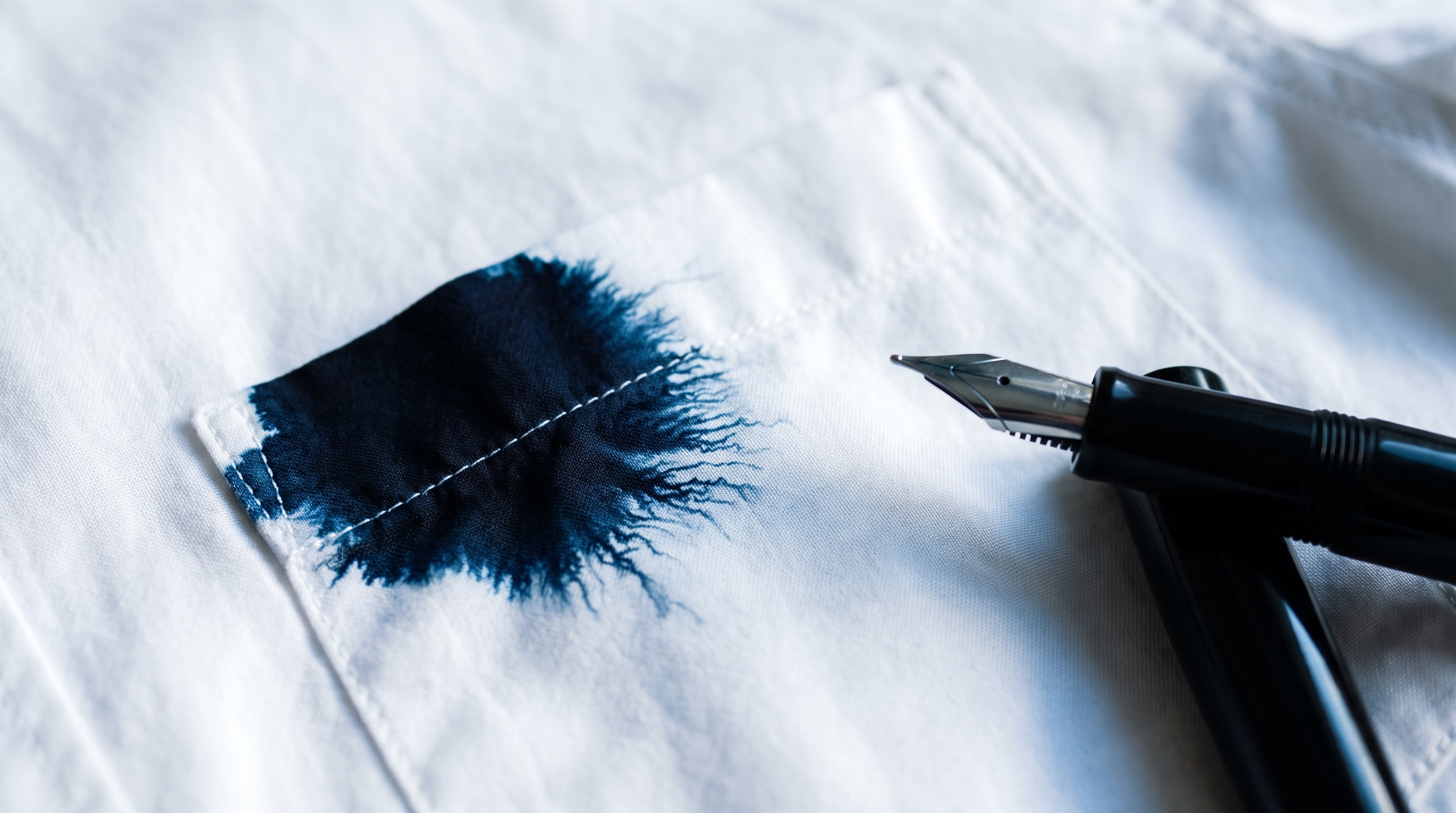
Fountain-pen ink is water-based, so cool water is the first move rather than solvent. Flush from the back under a cool tap until the water runs clear, then treat with detergent and wash. Iron-gall inks are the exception and can be genuinely permanent; treat fast and expect a shadow.
How do you remove foundation, lipstick and cosmetics?
These are wax and oil plus pigment, so they are a mixed stain and the order matters:
- Lift any solid residue with the edge of a blunt knife. Do not press.
- Treat the oil and wax first — micellar water for light foundation, or washing-up liquid for heavier cosmetics.
- Then treat any remaining colour as a dye stain: oxygen bleach on white cotton, or repeat applications of detergent on colours.
- Wash at 40°C and check dry before drying properly.
What about colour run and dye transfer?
Different problem, different fix. Dye transfer happens when a loose dye leaves one garment in the wash and attaches to another, and the critical rule is that a colour-run garment must not be dried — heat sets the transferred dye. Rewash immediately with detergent and, on whites and colour-fast items, a colour-run remover or an oxygen-bleach soak.
| Stain | First agent | Direction | Care |
|---|---|---|---|
| Ballpoint ink | Surgical spirit / isopropyl alcohol | Back of fabric, onto absorbent paper | Test on a seam — solvents lift fabric dye |
| Fountain-pen ink | Cool water | Back of fabric, under a tap | Iron-gall inks may be permanent |
| Permanent marker | Surgical spirit | Back of fabric, repeated | Expect a shadow |
| Foundation, lipstick | Micellar water or washing-up liquid | Blot from the front, gently | Lift solids first, never press |
| Dye transfer | Rewash immediately | Whole garment | Do not dry until it has cleared |
Swipe to see the full table
Solvents remove dye. That is the whole point of them, and they cannot tell the difference between the ink you want gone and the indigo you want to keep. Test surgical spirit on an inside seam or hem and wait for it to dry before going near the visible face of a coloured garment.
Element's part in this one comes last and matters more than it sounds. Every method above ends with a proper wash — to clear the loosened pigment, the solvent residue and the treatment product together. Skip it and you get a clean patch surrounded by a faint halo of everything you just dissolved.
Full dose, sheet into the empty drum before the clothes, at the warmest temperature the care label allows. Our sheets are biological — enzymes and surfactants together — which is what handles the mixed oil-and-pigment residue cosmetics leave behind.
Not on wool, silk or cashmere. Those 3 get a dedicated wool wash, here as everywhere else.
See the sheetsKeep reading
Written and fact-checked by the Element for Men editorial team. General guidance only — always follow the care label on the garment.