Protein Stains: Blood, Sweat, Egg and Milk
4 stains, 1 mechanism, and 1 rule that decides whether they come out at all. Get the temperature wrong at the first step and nothing afterwards will help.
Rinse in cold water immediately, then wash with a biological detergent containing protease enzymes. Never use hot water and never tumble dry until the mark has gone — heat denatures protein and bonds it permanently into the fibre.
Why protein stains behave the way they do
What counts as a protein stain?
Blood, sweat, egg, milk and dairy, gravy and meat juices, and most bodily fluids. They share 1 chemistry: large protein molecules that are soluble in cold water while they remain in their natural folded state, and insoluble once that structure is destroyed.
Why does heat set a protein stain?
Because heat denatures protein — it unfolds the molecule and lets it cross-link with itself and with the fibre. It is exactly what happens when a raw egg white hits a hot pan: clear and runny becomes white and solid, and the change does not reverse. A blood stain in a 60°C wash undergoes the same transformation, on cotton.
A protein stain in a hot wash is a fried egg. You cannot un-cook it.
The method
How do you remove a fresh protein stain?
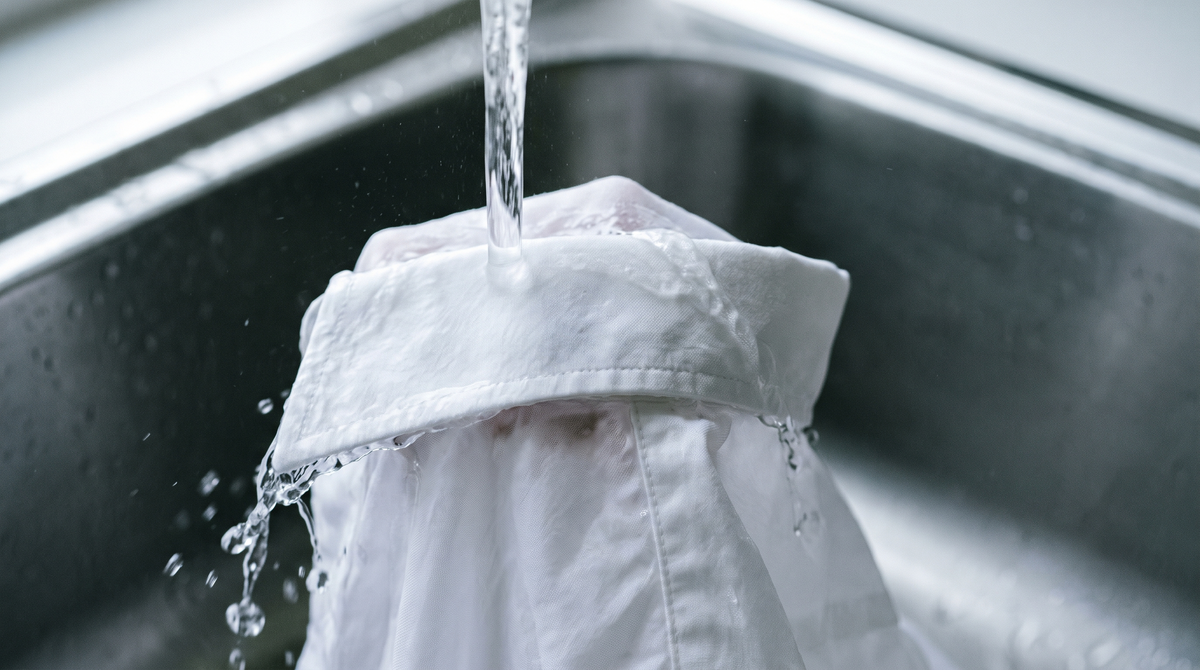
- Rinse under a cold tap immediately, from the back of the fabric so the stain is pushed out rather than through. Keep going until the water runs clear.
- Work a little biological detergent into the mark and leave it 15 to 30 minutes. This is where the enzymes do their work.
- Wash at 30°C or 40°C with a biological detergent, on a full cycle rather than a quick wash.
- Check the fabric while it is still wet. A wet mark still faintly there needs a second pass.
- Air-dry. Do not tumble dry until you are certain the stain has cleared.
Cold water first, always. Heat sets protein — a hot tap, a warm wash or a tumble dryer will cook the stain into the fibre and turn a removable mark into a permanent one.
How do you remove dried blood?
Soak in cold water for an hour, changing the water when it colours, then apply biological detergent directly and leave it an hour before washing at 30°C or 40°C. Dried blood is slower but often still removable, because the protein has dried rather than been cooked. Blood that has been through a hot wash or a dryer usually has not.
What about yellow underarm marks?
Yellow underarm discolouration is not really a sweat stain — sweat itself is nearly colourless. The yellowing is a reaction between sweat proteins, body oils and the aluminium salts in antiperspirant, built up over many wears. It responds to enzyme pre-treatment and patience rather than one dramatic intervention, and it is far easier to prevent: let antiperspirant dry fully before dressing, and wash shirts after each wear.
What not to do
Can you use biological detergent on wool, silk and cashmere?
No. This is the one important exception in the category, and it is worth stating plainly: wool, silk and cashmere are protein. A protease enzyme cannot distinguish between the protein in the stain and the protein in the fibre, so a biological detergent will thin and dull those fabrics over repeated washes.
For a protein stain on a protein fibre, use cold water, a dedicated wool wash, gentle blotting and patience — and accept that some marks on silk are a job for a specialist. This applies to every biological detergent on the market, ours included.
| Fabric | Cold rinse | Biological detergent | Notes |
|---|---|---|---|
| Cotton, linen | Yes | Yes | The straightforward case |
| Polyester, technical | Yes | Yes | Enzyme-safe; rinse well, no softener |
| Wool, cashmere | Yes, briefly | No | Dedicated wool wash only |
| Silk | Blot, do not soak | No | Specialist cleaning for anything significant |
| Denim | Yes | Yes | Wash inside out to protect the indigo |
Swipe to see the full table
Element's detergent sheets are biological — they contain enzymes. That is precisely what makes them effective on this category of stain, and it is why we say so on the pack rather than leaving it to be inferred.
It also means they are the wrong tool for wool, silk and cashmere. Use a dedicated wool wash for those 3. We would rather tell you that than sell you a wash that quietly ruins a jumper.
Designed to dissolve and work from 30°C, which matters here more than in most categories — on protein stains a cool wash is not a compromise, it is the correct setting. 30 sheets, 30 washes.
See the sheetsKeep reading
Written and fact-checked by the Element for Men editorial team. General guidance only — always follow the care label on the garment.