Scent Layering: How to Build Laundry Scent That Actually Lasts
Fragrance houses have layered scent for a century. Applied to a washing machine the sequence is short — 4 stages, in 1 order, with 1 mistake that undoes all of them.
Scent layering means introducing fragrance at more than 1 stage of the wash so that something survives the rinse. The working order is detergent in the drum, softener in the ❀ compartment, controlled drying, then storage. Doubling up in a single stage does not work; spreading across stages does.
The principle
Why does laundry scent disappear so fast?
Because the machine is deliberately trying to remove it. The wash cycle lifts soil off the fibre and suspends it in water. The rinse cycle then flushes that water away — and everything dissolved in it, fragrance included. A detergent that smells wonderful in the drawer can leave almost nothing behind by the time the drum stops.
Layering works because the last thing to touch the fabric is the thing that stays. Anything deposited during the final rinse has nothing after it to wash it off.
The last thing to touch the fabric is the thing that stays. Everything else is negotiable.
The 4 stages, in order
Stage 1 — detergent, in the drum
Clean fabric holds fragrance better than dirty fabric, so this stage matters even though most of its scent will not survive. The mechanical point is placement: sheets and pods go into the empty drum before the clothes, never the drawer. In the drawer they dissolve incompletely and deliver a fraction of what you paid for.
Body oil left in fibre is the biggest enemy of laundry scent. It turns slowly, and the note it produces sits underneath any fragrance added on top. If clothes smell clean from the wardrobe and sour by mid-afternoon, that is the cause, and no amount of added perfume fixes it.
Stage 2 — softener, in the ❀ compartment
This is where the scent you actually smell tomorrow is deposited. The flower-marked compartment is flushed during the final rinse, so its contents are the last thing to reach the fibre. Fill to the marked line and no further — overfilling makes it siphon early and dump into the wash instead.
Many softeners use encapsulated fragrance: microscopic shells that sit on the fibre and rupture under friction. That is why a shirt smells quiet in the wardrobe and stronger once you have been moving in it for an hour. It is working as designed.
Stage 3 — drying
Drying is a scent stage, not a neutral one. Heat drives off volatile top notes, so a hot tumble dry strips the brightest part of a fragrance. Drying indoors on a packed airer in still air does the opposite kind of damage: fabric stays damp long enough for bacteria to establish, and that musty note outlasts anything you added.
- Best: outdoors in moving air, or indoors with a window cracked and the airer not overloaded.
- Acceptable: a low or eco tumble setting, gentler on top notes than a hot cycle.
- Worst: a packed airer in a closed, unheated room.
Stage 4 — storage
A wardrobe is a small enclosed space with its own smell, which your clothes adopt within a week. Fragrance transfers both ways. Clean shelves, some air circulation, and never putting anything away while it is even faintly damp will preserve more scent than most people expect.
Detergent and softener neutralise each other. Detergent surfactants are anionic; softening agents are cationic. Put them in the drum together and they bind, cancel out and rinse away — you have paid for both and received neither. Sheet in the drum. Softener in the ❀ compartment. Never the same place.
Doing it well
Should you layer the same scent or different ones?
The same one, in almost every case. 2 different laundry fragrances on the same load do not compose into a third thing — they compete, and the result reads muddled. This is the opposite of fine-fragrance layering, where products are designed as a range to sit together. Match the detergent and the softener and you get 1 coherent scent with more staying power.
Which fabrics hold scent best?
| Fabric | Scent retention | Why |
|---|---|---|
| Cotton, especially towelling | Very good | High surface area, absorbent cellulose fibre |
| Linen | Good | Absorbent, though the open weave releases faster |
| Wool | Very good | Complex fibre surface — but use a wool wash, not a biological detergent |
| Polyester and technical fabric | Poor | Hydrophobic and smooth; holds body oil readily and fragrance badly |
| Denim | Good | Heavy cotton, plenty of substrate |
Swipe to see the full table
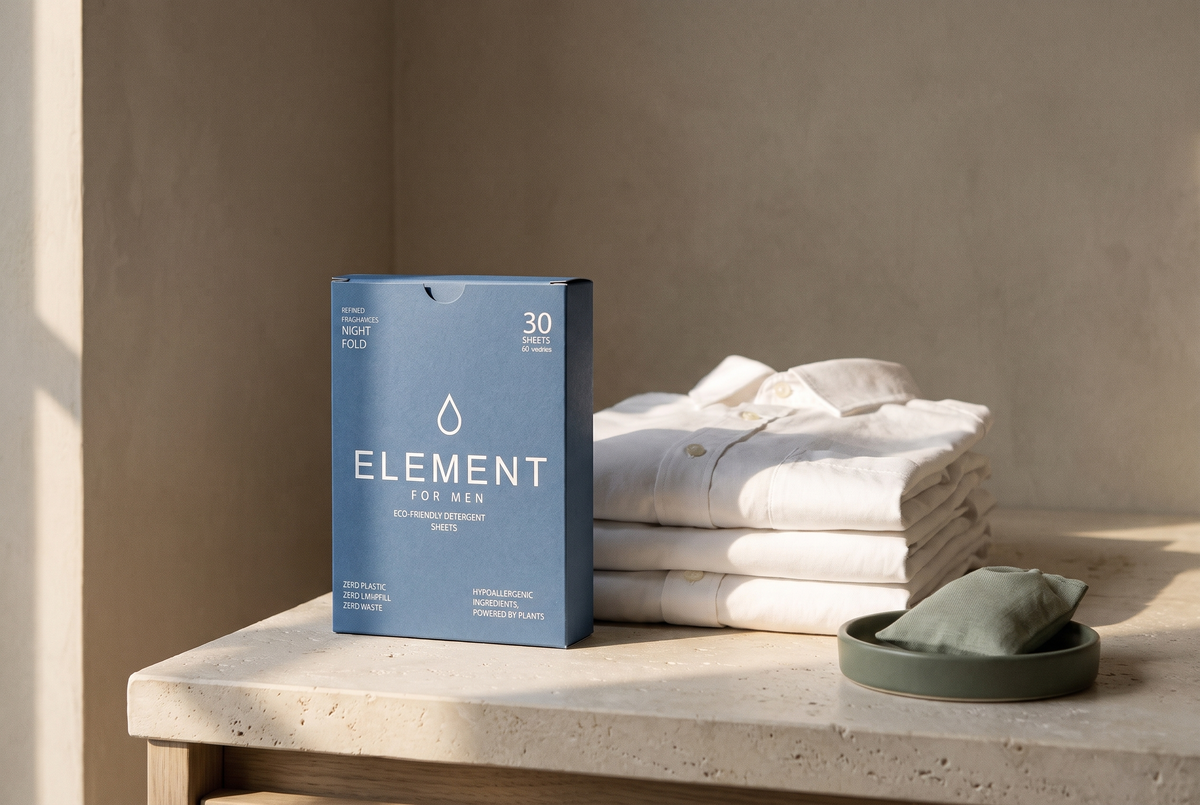
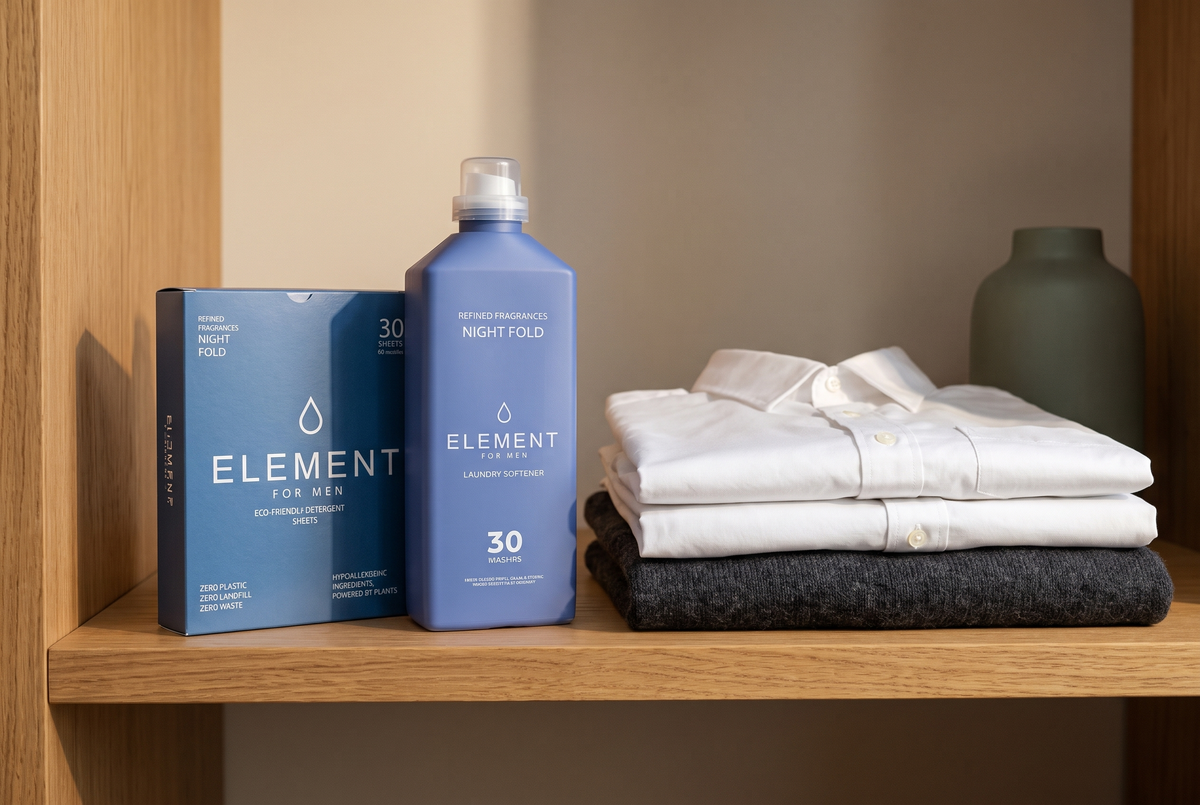
Layering only works if the 2 stages agree with each other, which is why Element makes both formats in the same 3 scents — Night Fold, Ocean Air and Wild Spice. Sheet in the drum, softener in the ❀ compartment, 1 fragrance across both stages rather than 2 competing.
Built with professional fragrance houses to IFRA standards, with a top, a heart and a base rather than a single flat accord. Night Fold — lemon, lavender, clean musk, patchouli. Ocean Air — airy freshness, sandalwood, vanilla, warm amber. Wild Spice — bergamot, pepper, patchouli, warm amber.
The bundle is 30 sheets and a 1L softener in 1 scent — 30 complete washes, £14.99.
See the bundlesKeep reading
Written and fact-checked by the Element for Men editorial team. General guidance only — always follow the care label on the garment.