How laundry fragrance actually works
Scent is the most-discussed and least-explained part of laundry. Most of what determines whether your clothes smell good has nothing to do with how strong the product smells in the bottle. Here is the mechanism.
The science of laundry scent
Why doesn't my laundry smell of anything after washing?
Usually one of four things. The drum is overloaded, so fabric never moves freely through the rinse where softener deposits. You are dosing into the wrong compartment. You are washing too cold to remove the soil the fragrance has to compete with. Or the fragrance is mostly top notes, which evaporate within hours of drying. Fix the load size first — it is the most common cause and it is free.
How does fragrance stay on fabric at all?
Deposition and retention. Fragrance molecules bind to fibre either directly or via the cationic softener film that carries them. Then they release gradually as the fabric warms and moves. Retention depends on molecular weight — heavier molecules cling and release slowly, lighter ones flash off. It is why a scent can be intense from the bottle and gone by Tuesday.
What are top, heart and base notes?
The same structure perfumery uses. Top notes are light, volatile molecules — citrus, aromatics — that hit first and vanish fastest. Heart notes are the main character, emerging as the tops fade. Base notes are heavy and slow — woods, amber, musk — and they are what is still there days later. A laundry fragrance that is all top notes smells fantastic at the machine and dead in the wardrobe.
Why does my laundry smell strong wet and weak dry?
Evaporation is doing its job. Water carries volatile fragrance molecules off with it as it leaves the fabric, so a large part of the top note goes with the drying. What remains is what actually bound to the fibre. Anything you smell over the drying rack is fragrance leaving, not fragrance staying.
What are encapsulated fragrances?
Fragrance sealed in microscopic shells that stick to fabric and only rupture under friction — movement, or your hand brushing the sleeve. It is why some products smell of little until you touch them, then release a burst. It is a genuine and clever technology for longevity. Our own fabric softener uses fragrance microcapsules, which is what carries scent through to the dry garment.
How long should laundry scent last?
Days on stored fabric, hours of noticeable presence on a worn garment. Anything promising weeks of strong scent is either using encapsulation, using a very heavy base, or overstating. Be sceptical of long-lasting claims with no mechanism attached to them.
Why can't I smell my own laundry?
Olfactory adaptation — your nose stops reporting a constant, unchanging smell within minutes so it can notice new ones. It is why you cannot smell your own home or your own aftershave. Your laundry almost certainly smells of more than you think it does. Other people can smell it perfectly well.
Does scent cover up dirt?
It masks it; it does not address it. Fragrance sits on top of whatever the wash left behind, so a garment can smell good and still carry the sebum that will smell bad the moment it is warm. That is the clean-but-not-clean effect, and no amount of fragrance fixes it. Get the wash right first.
Does more product mean more scent?
No, and this is where most people waste money. Deposition saturates — once the fibre has taken up what it can hold, extra product has nowhere to go. It builds up in the fabric and the machine instead, and over-dosed fabric holds odour better. More product past the right dose makes things worse, not stronger.
Why does the same product smell different on different fabrics?
Fibre chemistry. Cotton is hydrophilic and porous, and holds fragrance differently from polyester, which is oleophilic and binds oily fragrance components more tightly. Wool holds scent well; silk barely at all. The same softener on a cotton shirt and a polyester tee genuinely reads differently.
Making scent last
How do I make my laundry smell better?
In order of impact, and the first two are free. Do not overload the drum — fabric must move freely for the rinse to deposit anything. Rinse properly — residue holds soil that competes with the fragrance. Dry with airflow — slow damp drying breeds the musty note that overrides everything. Then, and only then, match the sheet and the softener in the same scent so the fragrance layers.
Does layering detergent and softener in the same scent work?
Yes, and it is the single most effective thing you can do for laundry scent. Two products in the same fragrance deposit the same molecules at two stages of the cycle, reinforcing rather than competing. Two different fragrances fight, and the result is usually less pleasant than either alone.
Why does mixing brands make laundry smell odd?
Fragrances are compositions, not ingredients. Two well-made perfumes layered arbitrarily produce a third thing nobody designed — and clashing top notes read as a chemical smell rather than as either fragrance. This is why matched sets exist.
Does air drying or tumble drying preserve scent better?
Air drying, generally. Tumble heat drives off volatiles faster and more aggressively than ambient air. Air drying outdoors gives you the best result of all — though sunlight fades dark colours, so hang darks inside out or in shade.
Does line-dried laundry really smell different?
Yes, and there is real chemistry behind it. Sunlight drives photochemical reactions in the fabric that generate aldehydes and ketones — the same class of light, airy molecules perfumers use to signal freshness. The smell of line-dried laundry is not sentimentality; it is a genuine set of compounds that only form in UV.
How should I store clothes so they keep their scent?
Fully dry, with air around them. Any residual damp turns musty and the musty note dominates everything. Do not pack a wardrobe solid — fabric needs airflow. And do not store clothes dirty; sebum oxidises in storage and that smell will outlast any fragrance.
Why do my clothes smell of the wardrobe?
Because the wardrobe smells, and fabric is an excellent adsorbent. A closed, unventilated wooden space with no airflow develops its own odour, and textiles pick it up over weeks. Air the wardrobe, leave gaps between garments, and make sure nothing goes in damp.
Does ironing affect scent?
Yes — it drives it off. Heat volatilises fragrance molecules, which is why a shirt smells strong at the ironing board and less afterwards. That burst is your scent leaving. Iron on the lowest temperature the fabric allows if you want to keep it.
Can I use perfume or essential oils in my wash?
We would not. Neat oil in a drum is an oil stain waiting to happen, especially on synthetics, and essential oils can degrade elastane. Undiluted fragrance is also a poor idea against skin. If you want scent in the wash, use something formulated to deposit and rinse correctly.
Are scent boosters worth it?
They work — usually encapsulation, delivering a friction-triggered burst. Our own fabric softener uses the same microcapsule technology, so the delivery system is not our objection. The objection is spending on a third product to solve a problem that load size and rinsing usually cause. Fix the mechanics first and see whether you still need one.
Choosing a scent
What is the most popular laundry fragrance in the UK?
The mass market is dominated by floral and powder-fresh accords — that is what the big brands have sold for decades and it is what most people mean by clean. It is a convention, not a rule. Nothing about laundry requires a floral, and the reason the aisle smells the way it does is history rather than chemistry.
What makes a fragrance smell masculine?
Convention, mostly. There are no inherently male molecules — but perfumery has long built men's fragrance around woody, spiced, aromatic and citrus-fresh structures, and around darker, drier bases. Those associations are learned, and they are so consistent that they read reliably. Laundry has largely ignored them.
Can laundry actually smell like cologne?
Up to a point, and it helps to be honest about the limits. A laundry fragrance is built from the same palette a perfumer uses, but it must survive water, surfactant, agitation and drying — conditions a skin fragrance never faces. So it is composed differently. It can carry the same character; it will not be the same thing as a bottle of eau de parfum.
Can I get a detergent that smells like a specific designer fragrance?
Not from us. Named designer fragrances are trademarks, and building a product around one — or naming it in marketing — is a trademark problem regardless of how close the composition gets. What we will say is that fragrance families are not owned by anyone. If you like a fresh, spicy, woody structure, look for a fresh, spicy, woody structure. That is how to find what you want without anyone pretending to be someone they are not.
What is the difference between eau de toilette and eau de parfum?
Concentration of perfume oil in the base, and therefore longevity. Eau de toilette typically runs around 5–15% oil; eau de parfum around 15–20%. Higher concentration means heavier presence and slower release, not automatically better — a well-built EDT can outperform a poorly-built EDP. The same logic governs how laundry fragrance is dosed.
Should my laundry scent match my aftershave?
Match or complement — do not fight. Clothes carry scent at close range all day, so a clashing pair is noticeable to everyone but you, because your own nose has adapted to both. Fresh laundry sits comfortably under most fragrance families; a heavy laundry scent under a heavy aftershave is a lot.
What scent should I use on bedding?
Something you would want to breathe for eight hours — which usually means something deeper and quieter rather than something bright. Bedding is the longest scent exposure you have and the one where over-fragrancing is most obvious. Darker, softer, less is the general rule.
What scent should I use on work shirts?
Something composed rather than loud. A shirt is worn close to other people in enclosed rooms for a full day, and the register you want is noticed-not-announced. Fresh and clean reads as professional; heavy and sweet reads as too much by mid-afternoon.
Element fragrances
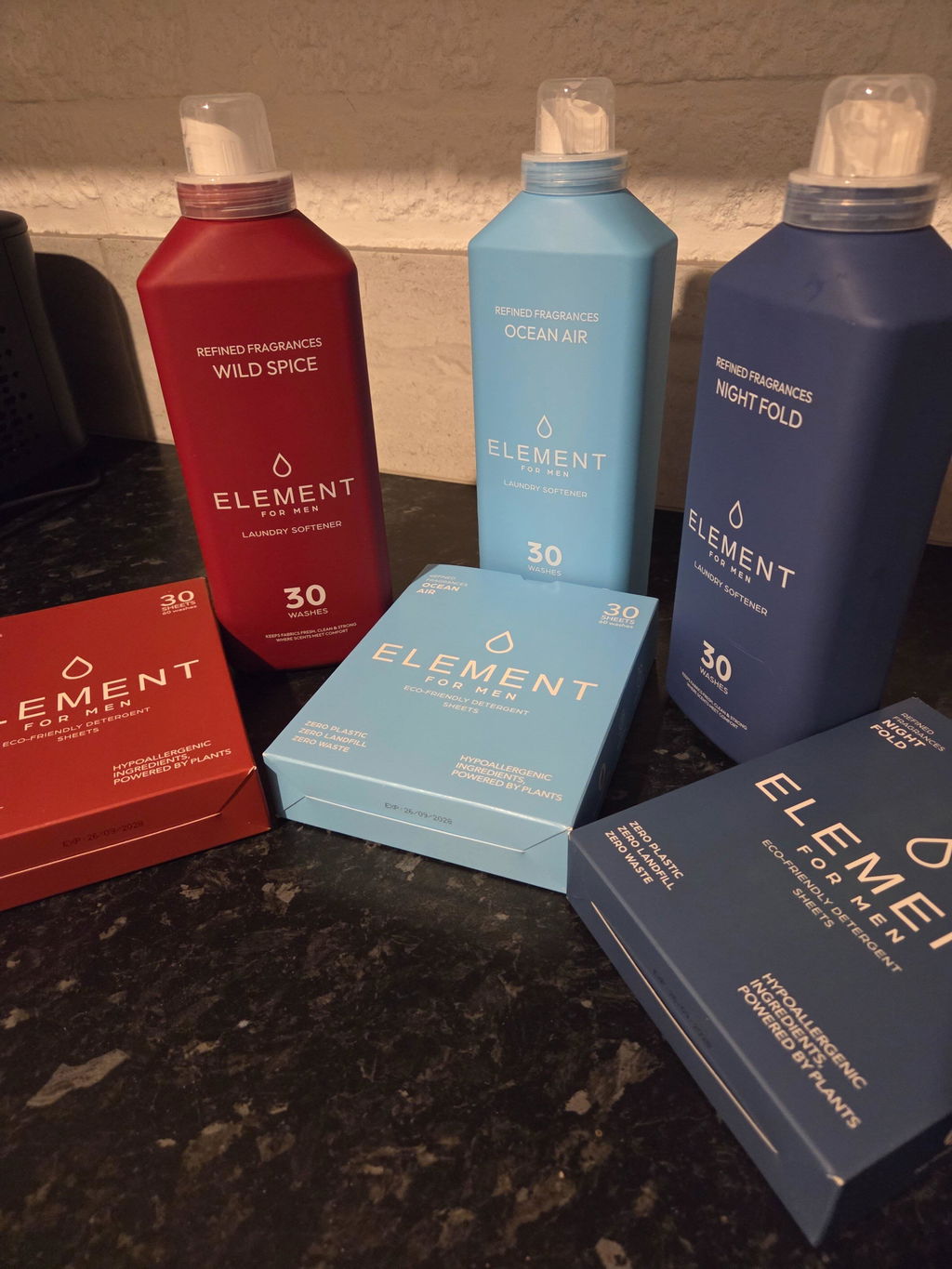
What does Wild Spice smell like?
Bold and warm — fresh top notes opening onto spicy, woody accords. The character of a confident evening cologne, worn by your clothes rather than your skin. It suits denim, casual wear and anything you want to have some presence.
What does Night Fold smell like?
Fresh and composed — lemon and lavender over clean musk and patchouli. It reads as a sophisticated after-dark fragrance and it is the go-to for work shirts and bedding, where you want depth rather than brightness.
What does Ocean Air smell like?
Soft and warm — airy freshness over sandalwood, vanilla and warm amber. The most versatile of the three, and one of our highest-rated. It suits everything and every season, and it is the easiest starting point if you are not sure.
Which Element scent should I choose?
Ocean Air if you want fresh and versatile and cannot decide. Night Fold if you want depth, and for shirts and bedding. Wild Spice if you want warmth and presence. There is a 10-second quiz if you would rather be told.
Why does Element only make three scents?
Because three well-built fragrances beat twelve mediocre ones, and because a fragrance you can commit to becomes a signature rather than a purchase. We would rather each one earn its place than fill a shelf.
How long does Element's scent last on clothes?
Days on stored fabric, in our experience and our customers'. We have not run formal longevity testing, so we are giving you an honest observation rather than a measured claim. What we can tell you is that matching the sheet and the softener in the same scent, not overloading the drum, and drying with airflow will do more for longevity than anything else.
Is Element's fragrance too strong?
It is built to be noticed, not announced — which is the whole register of the brand. If it reads too strong for you, use less softener rather than less detergent; the softener carries most of the scent load. And bear in mind olfactory adaptation cuts both ways: you will notice it far less than you did on day one.
Related: all laundry questions answered · fabric softener questions · take the scent quiz