How to Clean a Fabric Lampshade (Not Wash It)
Almost every fabric lampshade in a British house is glued rather than stitched, and that decides everything else.
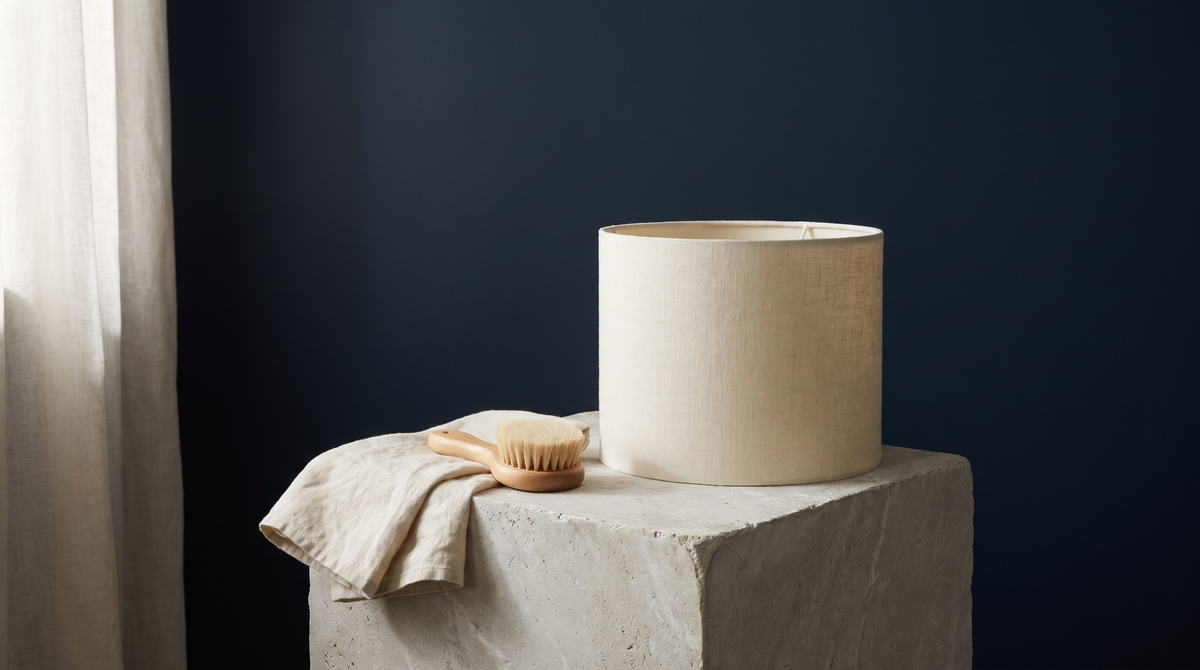
Most fabric lampshades cannot be washed. The fabric is glued to a styrene liner, water softens the adhesive, and the shade ripples and never sits flat again. Dust it dry with a soft brush, spot-clean with a barely damp cloth, and submerge only a shade stitched to a bare wire frame.
Can you wash a fabric lampshade?
Only 1 kind of shade, and it is the rarer kind.
Construction decides it, not the fabric. Fabric glued to a styrene liner cannot get wet at all. Fabric stitched to a bare wire frame can take a short, cool dip.
| Shade | Verdict | Why |
|---|---|---|
| Hard-backed drum or empire | No water at all | The fabric is glued to a styrene liner |
| Fabric stitched to a bare wire frame | Short, cool hand wash | Nothing glued to fail |
| Pleated silk | Dust only | The pleats are fixed at both rings |
| Paper, card or parchment | Dust only | Water cockles it permanently |
| PVC or plastic-coated | Wipe with a damp cloth | Washable, but not submersible |
| Vintage shade with a taped frame | Dust only, or a specialist | The tape and the adhesive are the oldest part |
Scroll to see the full table
How do you tell a glued shade from a stitched one?
Look inside, at the top and bottom rings.
A glued shade shows a smooth rolled edge wrapping over the ring with no thread visible, and the lining is a continuous plastic sheet that crackles faintly if you press it. A stitched shade shows overstitching along both rings and a fabric lining with seams. It takes 10 seconds and it is the only check that matters.
Press the inside wall. A hard-backed shade is rigid and faintly glossy where the styrene sits behind the fabric. A stitched shade flexes, and feels like cloth from both sides.
How do you dust a lampshade properly?
Dry, downward, and with something soft.
- Take the shade off the lamp and work over a bin, or outside.
- Brush downward with a soft clothes brush or a clean paintbrush, following the weave.
- Lift the rest with a lint roller, or a dry sponge pressed on and peeled off.
- Finish the inside, where the deposit is always heavier.
Do not put a vacuum nozzle on the fabric: suction pulls a glued panel off its ring, and the ring holds the shade in shape.
How do you spot-clean a mark on a lampshade?
Barely damp, blotted, and dried quickly.
- Test low down on the back of the shade first.
- Wring a white cloth until it is almost dry, with a trace of mild detergent in the water.
- Blot the mark, then blot again with a clean damp cloth and a dry one. Do not rub, and do not let water run down the fabric.
- Leave it to dry in moving air, away from heat.
Water running down a shade leaves a tide mark where the dissolved deposit dries at the edge of the wet patch — a worse mark than the one you started with.
Why do lampshades go brown at the top?
Because a lamp is a chimney, and the top edge is the flue.
A warm bulb drives a slow convection current up through the shade. That current carries whatever is in the room air with it — aerosolised cooking fat, candle soot, dust, skin oil — and leaves it inside the shade, heaviest at the top where the air exits fastest. Then the heat does the rest: it accelerates the oxidation of that oily film, the same browning reaction as a cut apple, and bakes it into the weave.
The stain on a lampshade is not dust. It is cooked air.
2 things follow. The discolouration is a chemically changed deposit rather than loose soil, so brushing will not shift it and water largely will not either. And an LED bulb removes the heat that bakes it, which is the only real prevention there is.
Can you wash a shade stitched to a wire frame?
Yes, briefly, and only if the frame is sound.
- Fill a bath with cool water and a little mild detergent.
- Dip the shade and swish it for 2 minutes. No soaking.
- Rinse under a cool shower until the water runs clear.
- Shake the water off, stand it upright on a towel, and dry it fast in moving air.
Speed is the whole technique. A wire frame is painted steel, and one left wet for hours leaves rust marks through the fabric from the inside — a stain that arrives after the wash looked like it worked.
How often should you clean a lampshade?
- Living room and bedroom: dust every 3 months.
- Kitchen or open-plan: dust monthly, because the oily film is continuous.
- Over a candle or a wood burner: monthly.
- Spot-clean: when you notice the mark, not later.
This will not work if the shade has already yellowed through. A film heat-aged into a textured weave does not come out, and a glued shade cannot be taken apart and re-covered. At that point it is a new shade, which is the cheapest part of a lamp.
Not here. A lampshade is dusted, and nothing in a laundry cupboard improves on a soft brush.
The same airborne film settles on everything soft that you can wash — cushion covers, curtains, throws. That is an ordinary warm wash with 1 sheet into the empty drum before the fabric goes in, never the drawer. 30 sheets — 30 washes, up to 60 if you halve them.
See the detergent sheetsKeep reading
Written and fact-checked by the Element for Men editorial team. General guidance only — always follow the care label on the item.