



Article: How to Clean a Tweed Jacket Without Washing It
How to Clean a Tweed Jacket Without Washing It
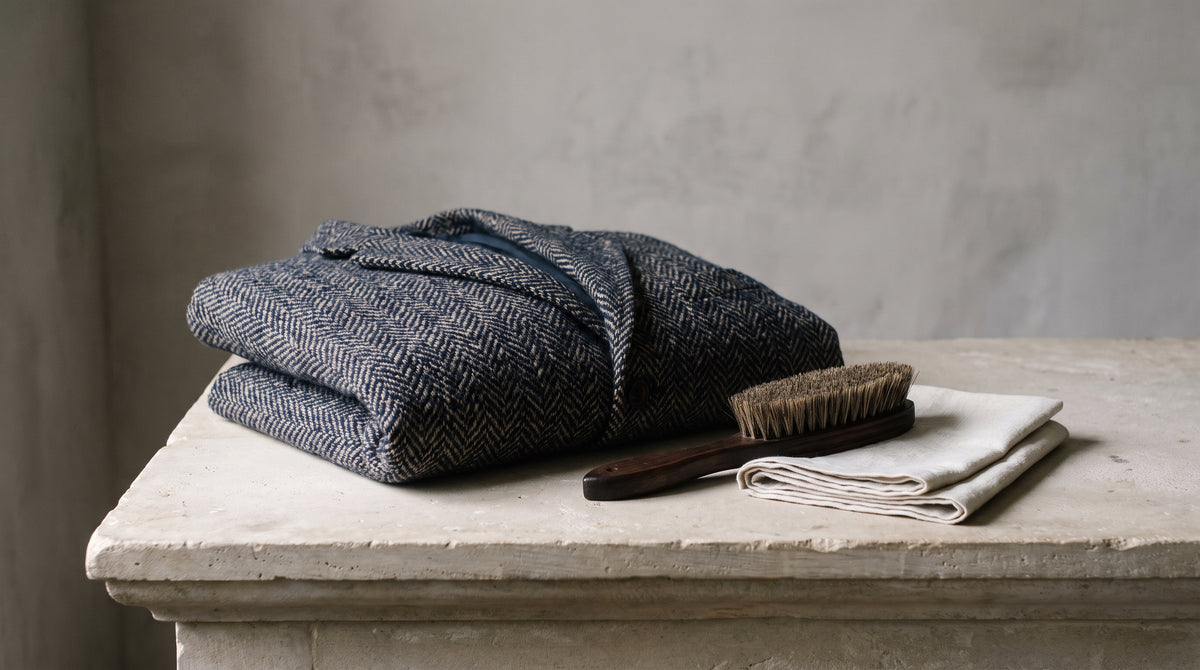
Tweed is a woollen cloth, not a worsted one. That is why it is brushed rather than washed.
Do not wash a tailored tweed jacket. Brush it after every wear, air it overnight, blot marks with cold water, and have it dry cleaned once a season at most.
The hairy surface that makes tweed look like tweed is also what keeps dirt out of it.
For the shirts worn under it, Element makes laundry detergent sheets.
Can you wash a tweed jacket?
No, and the reason is the yarn rather than the fibre.
Tweed is a woollen cloth: the wool is carded rather than combed, so the fibres lie in every direction and the yarn is spun loosely with air inside it. A worsted suiting is the opposite — combed so the fibres lie parallel, then spun tight and smooth. Both are wool. Only one is mostly air.
Water and agitation collapse that air, and the fibre scales lock as it happens — the same felting that shrinks a wool jumper. A jacket also carries interlining, shoulder shaping and a lining, all moving at different rates when wet. The cloth and the construction fail separately.
| The garment | What to do |
|---|---|
| Tailored tweed jacket or blazer | Brush, air, spot clean. Dry clean only when truly soiled |
| Unlined tweed waistcoat | Brush and air. Hand wash cool only if the label allows |
| Flat cap | Never submerge. The stiffened peak will not recover |
| Tweed-look blend with polyester | Follow the label. Not woollen cloth, and behaves differently |
Scroll to see the full table
Why is tweed brushed instead of washed?
Because on a hairy cloth, dirt sits on the surface instead of sinking into it.
Carded yarn leaves fibre ends projecting from the cloth, so the face of a tweed is a thicket, not a sheet. Dust, crumbs, pollen and street grit come to rest on the tips of those fibres and never reach the weave. A brush lifts them back off. A wash swells the fibre around them instead.
On a smooth cloth, dirt has to be dissolved. On a hairy one, it can simply be lifted off.
How do you brush a tweed jacket properly?
Dry, on a hanger, with a natural-bristle brush and short firm strokes downwards.
Under 2 minutes, and it is the whole maintenance routine. Done after every wear, it is what keeps the jacket out of the dry cleaner's for months.
- Hang it on a broad hanger and fasten the top button so the fronts hold their shape.
- Work downwards — collar, shoulders, back, fronts, sleeves. Soil falls, so never go back up.
- Short firm strokes in the direction the surface lies. It is a lift, not a scrub.
- Finish on the cuffs and the collar fold, which carry hand and hair oil.
- Turn the pockets out and shake them.
On corduroy you brush the pile damp, to stand it up. On tweed you brush dry cloth, to take soil off. Brush a wet tweed and you are rubbing wet wool against itself, which is how felting starts.
How do you get a smell out of tweed without washing it?
Moving air and time. Wool releases odour far more readily than cotton does.
Wool is hygroscopic: it takes moisture into the fibre and gives it back to the air, and odour leaves with it. A night on a hanger in moving air clears a kitchen or a pub. Outside the wardrobe, and nowhere near a radiator.
This will not work if the smell is in the lining rather than the cloth. Linings are usually viscose or polyester, and polyester attracts oil and holds it, which is where the smell lives. Airing a wool shell does nothing for a synthetic lining — that one is for the dry cleaner.
How often should you dry clean a tweed jacket?
Once a season at most, and only when it is visibly dirty.
Solvent cleaning is good at oil and poor at everything water-borne, so a jacket that smells of a long evening does not need it. Each visit also brings handling, pressing and heat, and pressing flattens a woollen surface. The cloth usually outlives its own cleaning history.
A dry-clean-only label is a survival instruction, not a schedule: it says what the garment tolerates, not that you should use it.
What do you do about a stain on tweed?
Blot it, never rub it, and work from the outside of the mark inwards.
The surface works in your favour: a splash sits on the fibre ends for a few seconds before it wicks into the yarn, so speed beats product. Press a dry white cloth on to take the liquid up, then blot with a second cloth damped with cold water, working from the edge inwards.
Mud is the exception. Let it dry completely, then brush it off — wet mud worked with a cloth goes into the weave. None of this helps once a mark has been pressed with an iron. Heat sets it, and from there it is a professional's problem.
Honestly, it does not. Not on this garment. Our sheets contain enzymes, enzymes break down protein, and wool is protein — so a tweed jacket is one of the few things we would tell you to keep our detergent away from. Use a dedicated wool wash on wool, cashmere and silk.
What goes underneath it is ours. 1 sheet into the empty drum before the clothes go in, never the drawer. 30 sheets — 30 washes, up to 60 if you halve them.
See the detergent sheetsKeep reading
Written and fact-checked by the Element for Men editorial team. General guidance only — always follow the care label on the item.
Now you know.

