Article: How Long Can Wet Washing Sit in the Machine?
How Long Can Wet Washing Sit in the Machine?
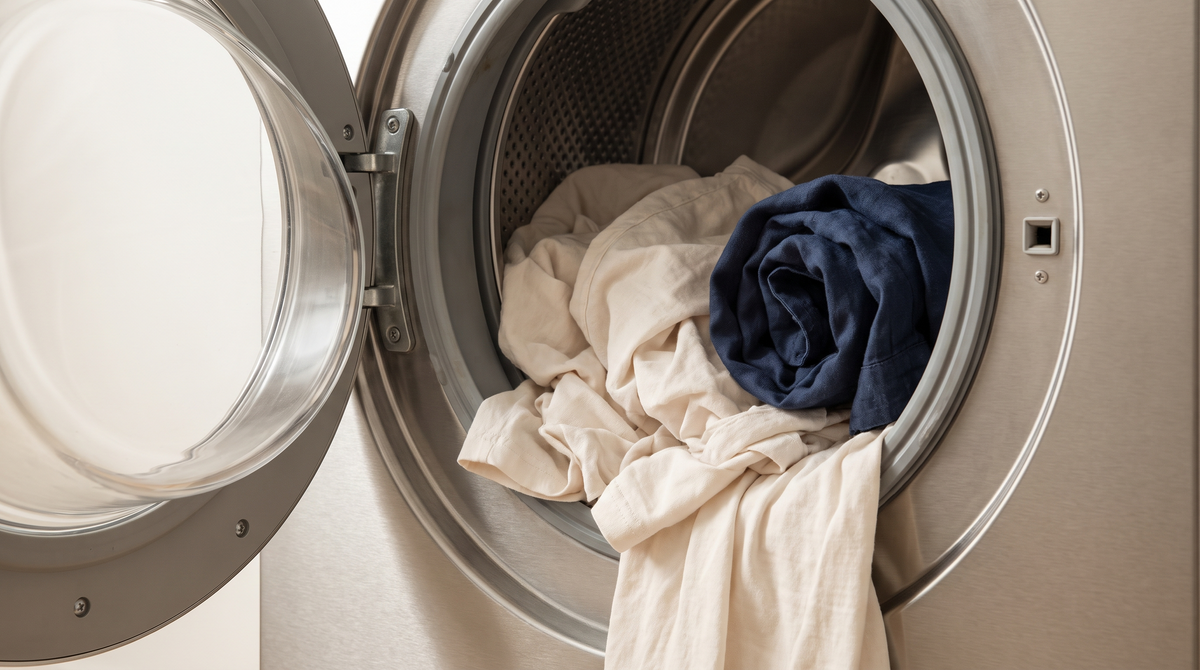
Around 8 to 12 hours in a cool British house, and less in a warm room. The clock is not about time — it is about how fast a warm, damp, sealed drum lets bacteria restart. Smell it before you rewash it.
Open the door and smell the load while it is still damp. Damp fabric releases odour; dry fabric hides it until body heat brings it back. If it smells of nothing, hang it. If it smells sour or of wet cardboard, rewash — but with less detergent, not more.
How long can you leave wet washing in the washing machine?
Overnight is usually survivable. A full day is not, and a warm day is worse than a long one.
A finished load leaves a hot, alkaline environment that was hostile to almost everything living in it. The moment the cycle ends, that advantage drains away. The drum cools to room temperature, the door seal holds the humidity in, and the fabric still carries 40% to 60% of its own weight in water. Warm, wet, enclosed and full of food is the exact specification of somewhere bacteria do well.
So it is a range rather than a number. In a cold hallway in January you have most of a day. In a kitchen in August you have a few hours.
What actually happens to clothes left in the drum?
Not much grows from nothing. What happens is that what survived wakes up.
Washing removes most of the body oil from fabric but not all of it, and a 30°C cycle suppresses the bacteria living on that oil rather than removing them. Give them warmth and moisture and they resume where they left off, producing the volatile compounds we register as a sour, stale smell. It is the same mechanism behind a shirt that smells clean in the wardrobe and smells of something else 20 minutes after you put it on.
Detergent residue. Excess detergent does not rinse away completely; it stays in the fibre as a soft film that holds moisture and oil against the fabric. A load over-dosed going in turns faster in the drum than a correctly dosed one. More detergent buys a shorter window, not a longer one.
Do you have to rewash washing that has been left overnight?
Often not, and this is where most people waste a cycle. If it smells of nothing, hang it. If it is faintly stale after a night in a cool room, dry it fast in moving air and it will be fine. Rewash only if it smells sour or of wet cardboard, if it has sat 2 days or more, or if the room was warm.
| What you find | Do this |
|---|---|
| Smells of nothing, or faintly of detergent | Hang it immediately. It is fine |
| Faintly stale, cool room, under a day | Dry it fast in moving air |
| Sour, or smells of wet cardboard | Rewash |
| Left 2 days or more, or the room was warm | Rewash, and check the machine |
| Visible marks | Rewash, then a maintenance wash |
Scroll to see the full table
Drying speed is what matters once you have decided it is fine. Moving air finishes the job; a crowded airer in a closed room extends the problem you just removed the clothes from.
The mistake is not leaving it in the machine. The mistake is adding more detergent to fix it.
How do you rescue a load that already smells?
Wash it hotter, with less, and rinse it twice.
- Run it at 60°C if the care label allows. Heat lifts the oil the residue clings to.
- Use half your normal dose. You are removing film, not adding to it.
- Add an extra rinse. This is the cycle where it earns its 15 minutes.
- Dry it straight away, in moving air or a low tumble.
- Skip the fabric softener on this load. It leaves a film too, and film is the problem you are solving.
If the same sour note returns on the next load, the fabric is not the problem. The machine is. A drum, seal and drawer that have only ever seen 30°C accumulate a residue layer that re-seeds every wash passing through, and no amount of rewashing clothes fixes a machine.
How do you stop it happening again?
3 habits, none of which take effort.
Set a delay finish rather than a start time, so the cycle ends when you are in the house. Leave the door and drawer open between washes so the drum dries instead of staying humid. And run 1 hot maintenance wash a month with an empty drum — the only routine that addresses what is in the machine rather than what is in the load.
And the limitation worth stating plainly: if the load is polyester gym kit that has already been through a tumble dryer while it smelled, a normal rewash will not shift it. Polyester attracts oil rather than repelling it, and dryer heat drives that oil deeper into the fibre and sets it there. At that point it is a soak, not a wash — and sometimes the honest answer is that the garment has had its life.
Dosing, mostly. 1 sheet, 1 load, with nothing to pour and nothing to over-measure — half a sheet for a small one. Most of the residue problem in this article starts with a measuring cap filled past the line.
Scent does not solve a forgotten load and we would not pretend otherwise. Get it dry first.
See the detergent sheetsKeep reading
Written and fact-checked by the Element for Men editorial team. General guidance only — always follow the care label on the garment.