Detergent sheets, honestly
Sheets are the newest format in a category that had not changed in decades, so there is a lot of noise about them — in both directions. Below is a straight account of how they work, what they are good at, and where they are not the right answer.
The basics
What are laundry detergent sheets?
A pre-measured dose of detergent held in a thin, dissolvable strip instead of suspended in water. A sheet carries the same functional ingredients as any detergent — surfactants, enzymes, builders, sequestrants — in a solid, concentrated form. You drop it in the drum and it dissolves. There is no water in it, which is what removes the bottle.
How do detergent sheets work?
The strip dissolves in the wash water and releases its actives. From there the chemistry is ordinary: surfactants lower surface tension so water can wet the fibre and lift oily soil, enzymes break down specific soil classes, and sequestrants lock up hardness ions. The delivery format is new; the cleaning mechanism is not.
Are laundry detergent sheets any good?
For everyday soil, yes — they clean, they dose precisely and they remove the plastic bottle. The honest caveat: independent testing has generally found sheets performing below liquids and pods on heavily-soiled, like-for-like loads, and the structural reason is real — a sheet has roughly 3g of dry mass to carry every active, which is meaningfully less than a liquid dose. We have not published our own comparative data, so we will not tell you ours is an exception. Sheets are a genuine trade of some cleaning headroom for convenience, weight and packaging.
Do detergent sheets dissolve properly?
Element's dissolve in seconds, in hot or cold water — we have watched it happen many times. Where people report undissolved sheets it is usually an overloaded drum, a sheet trapped inside a folded garment, or a sheet placed in the dispenser drawer rather than the drum. Put it in the empty drum first, then load on top.
Do detergent sheets work in cold water?
They dissolve in cold water, yes. Whether any detergent cleans well in cold water is a separate question and depends on the soil: cold is fine for light everyday loads, and poor at shifting sebum regardless of format. That is a temperature issue, not a sheet issue.
Where do you put a detergent sheet?
Directly in the drum, before you load the clothes — not in the dispenser drawer. The drawer is designed to flush liquid or powder with water; a sheet can stick there instead of reaching the wash. Drum first, clothes on top.
Do detergent sheets work in any washing machine?
Yes — front-loaders, top-loaders, washer-dryer combos. UK households run front-loading drums almost universally and sheets suit them well. There is no compatibility requirement beyond putting the sheet in the drum.
How many sheets do I need per wash?
One sheet for a normal load. The packaging instructs that a sheet can be split in half for smaller loads, which is where the up-to-60-washes figure comes from. For a very large or heavily-soiled load, use one full sheet and consider an extra rinse rather than adding a second sheet.
Can I use two sheets for a big load?
You can, but it is rarely the right answer. More detergent than the water can rinse away leaves residue in the fibre, which makes fabric feel stiff and holds soil. If a load is genuinely large, splitting it into two washes cleans better than double-dosing one.
Can you cut detergent sheets in half?
Yes — that is the intended use for smaller loads and it is how our packaging instructs dosing. Tear it roughly; precision does not matter. This is what makes 30 sheets stretch to up to 60 washes.
Sheets versus other formats
What is the difference between sheets, pods, liquid and powder?
Mostly water and mass. Liquid is actives suspended in water, so most of the bottle and its shipping weight is water. Pods are concentrated liquid in a dissolvable film — precise dosing, but you cannot adjust for load size. Powder carries a large builder package, which is why it tends to be strong in hard water and on whites. Sheets remove the water and the bottle entirely, at the cost of a small mass budget for actives.
Are detergent sheets cheaper than liquid?
Per wash they are competitive with mid-range liquids. Element sheets are £7.99 for 30, which is roughly 27p per full-sheet wash — less if you split sheets for small loads. Subscribers pay 10% less with free delivery. Against the cheapest supermarket own-brand liquid, no — sheets are not the budget option and we would not pretend otherwise.
Why are detergent sheets more expensive per wash than bulk liquid?
Scale and format. Bulk liquid is a mature, enormous-volume commodity sold at very thin margins in supermarkets, and most of what you are buying is water. Sheets are a newer format at lower volume with different manufacturing. If price per wash is your only criterion, bulk liquid wins. Sheets are competing on other things.
Do sheets clean as well as pods?
Independent testing has generally put pods and liquids ahead of sheets on heavily-soiled like-for-like loads. The mass budget explains why. For everyday soil the difference is not something most people notice. We have not run our own comparative testing, so we are giving you the category picture rather than a claim about ours.
Should I switch from liquid to sheets?
It depends what you are optimising for. Switch if you want no plastic bottles, no measuring, no spills, less storage and a fragrance you actually chose. Do not switch if you routinely wash heavily-soiled workwear and cleaning headroom is your priority — be honest with yourself about your loads.
Can I use sheets and liquid together?
There is no reason to. They do the same job and doubling the dose leaves residue rather than improving cleaning. If you are transitioning, finish the liquid, then move over.
Ingredients
Do detergent sheets contain dyes?
Element sheets are free from dyes — they are white. Dye in a detergent does nothing for cleaning; it is there to make the product look like the customer expects.
Do detergent sheets contain phosphates?
Ours do not. Phosphates were historically used as builders to soften water; modern sequestrants do that job instead. Element sheets are free from dyes and phosphates.
Do detergent sheets contain enzymes?
Yes. Enzymes are how modern detergent handles specific soil classes at reasonable temperatures — protease for protein, lipase for oils, amylase for starch. They are produced by fermentation, not extracted from plants, and any brand telling you its enzymes are plant-derived is describing something that does not exist.
Are detergent sheets vegan and cruelty-free?
Our enzymes are fermentation-derived rather than animal-derived, and we do not test on animals. We have not gone through third-party certification for either claim, so we will describe the position rather than display a badge we have not earned.
Practical
How do I store detergent sheets?
Somewhere dry, sealed. The whole design depends on dissolving on contact with water, which means humidity is the enemy — an open box in a steamy utility room or above a tumble dryer will find sheets tacky and stuck together. Keep the box closed and away from the machine.
My sheets have stuck together — are they ruined?
Usually not. They have absorbed moisture. They will still dissolve and still clean; they are just harder to separate. Tear off roughly what you need and use it — dosing does not have to be exact. Then move the box somewhere drier.
Do detergent sheets expire?
Enzyme activity declines slowly over a long period, so a very old sheet is somewhat less effective, but there is no cliff edge. Kept dry and sealed they are good well beyond any normal usage window. Moisture will ruin them long before age does.
Can I use detergent sheets for handwashing?
Yes. Dissolve a half sheet in warm water first and agitate until it is fully gone before adding the garment — undissolved detergent sitting directly against fabric can leave a mark. Rinse thoroughly; handwashing rinses less effectively than a machine.
Are detergent sheets good for travel?
They are the best format for it by a distance. No liquid, so no airport restriction, no leaks in a bag, and near-zero weight. A few sheets in a wash bag covers a fortnight of sink washing.
Can I use a detergent sheet in a washer-dryer?
Yes. Put it in the drum as normal. Worth knowing separately: washer-dryer combos are common in UK flats and are meaningfully weaker at drying than a dedicated dryer, so allow for longer drying and better airflow — damp fabric is where musty smells start.
Do sheets leave residue on clothes?
They should not. The sheet dissolves into the wash water rather than being left on the fabric, and there is no dye or filler to leave behind either. Residue almost always comes from over-dosing or under-rinsing rather than from the format. UK machines use relatively little water, so rinsing is less generous than people assume; an extra rinse solves most residue complaints.
Element sheets
How much are Element detergent sheets?
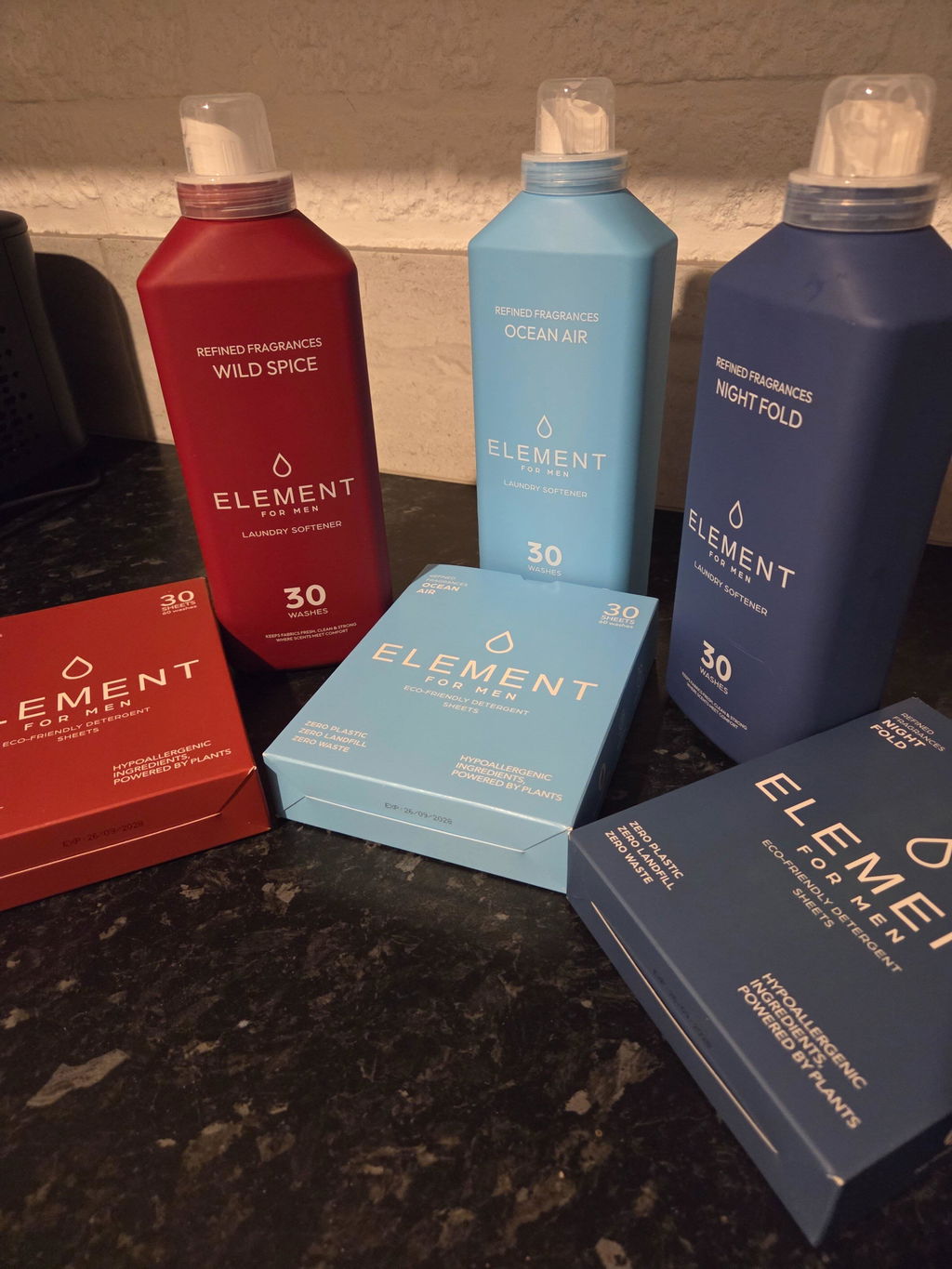
£7.99 for 30 sheets — up to 60 washes if you split them for smaller loads. Available in Wild Spice, Night Fold and Ocean Air. Bundled with the matching softener at £14.99, or as a Rotation Bundle at £19.99. Free UK delivery on orders of £35 or more; subscribers get 10% off and free delivery.
How many washes do I get from a box?
Up to 60. That assumes splitting sheets in half for smaller loads, which is how the packaging instructs dosing. A full sheet per load gives you 30. How far a box goes is genuinely your choice about dosing, so we quote the range rather than a single number.
What scents do Element sheets come in?
Three. Wild Spice — bergamot and pepper over patchouli and warm amber. Night Fold — lemon and lavender over clean musk and patchouli. Ocean Air — airy freshness, sandalwood, vanilla and warm amber. Each has a matching fabric softener so the scent layers rather than fights.
Can I mix scents?
Yes, and plenty of people do — Ocean Air on shirts, Night Fold on bedding. If you want the fragrance to read cleanly, match the sheet and the softener within a load rather than crossing them. Across different loads, mix freely.
Related: all laundry questions answered · laundry scent and fragrance questions · shop detergent sheets