The Best Smelling Fabric Conditioner (UK): How to Choose One That Lasts
Almost every fabric conditioner on a UK shelf claims long-lasting freshness, and most of them mean it sincerely. The gap between the claim and the experience is not usually dishonesty — it is fragrance construction.
Why laundry scent disappears
A fragrance is built in three layers. Top notes — citrus, light florals, sharp fresh accords — are small, volatile molecules. They hit immediately and evaporate within minutes to an hour. Heart notes sit underneath and carry the character. Base notes — woods, musks, ambers, resins — are heavy molecules that evaporate slowly and cling to fibre.
A conditioner designed to sell off the shelf leans on top notes, because that is what you smell when you open the cap in a supermarket aisle. It performs brilliantly in the two seconds that decide the purchase and poorly over the eight hours that decide whether you buy it again.
Then drying finishes the job. Whether on an airer or in a tumble dryer, warmth and airflow strip the lightest molecules first. Anything that survives to the point where you actually put the shirt on is, almost by definition, a base note.
What to look for instead
Read the description for base notes. Musk, cedar, sandalwood, amber, vetiver, patchouli, tonka. If a product describes itself only in terms of "fresh", "spring", "blossom" or "clean cotton", it is telling you about its top notes and nothing else.
Judge it on fabric, not in the bottle. The only test that matters is how a dry shirt smells the next morning. Bottle-sniffing selects for exactly the wrong quality.
Check whether the scent has a structure at all. Brands that treat fragrance seriously describe it the way a perfumer would. Brands that treat it as a commodity use adjectives.
Match it to your detergent. Two competing fragrances do not layer, they collide, and the result is usually a muddier version of the weaker one. One scent front to back is a real difference and costs nothing.
Where the scent actually lands
This is the part most people have backwards. Detergent does not carry scent well, because detergent's job is to lift material off fabric and be rinsed away — and the fragrance goes with it. Conditioner is released in the final rinse, after the detergent has gone, and deposits onto clean fibre with nothing following it. Nothing rinses it off.
Which means the conditioner, not the detergent, is doing most of the work on how your clothes smell tomorrow. If your laundry smells of nothing, the fix is more often the conditioner than the detergent. Worth checking you are also putting it in the right compartment — the flower-marked one, not the drum, and the drawer symbols are explained here.
The loads where you should skip it anyway
Scent is not a reason to use conditioner on everything. Keep it off technical sportswear, where the conditioning layer interferes with moisture-wicking. Use it every few washes rather than every wash on towels, where build-up gradually reduces absorbency. And skip anything whose care label says not to.
How Element approaches it
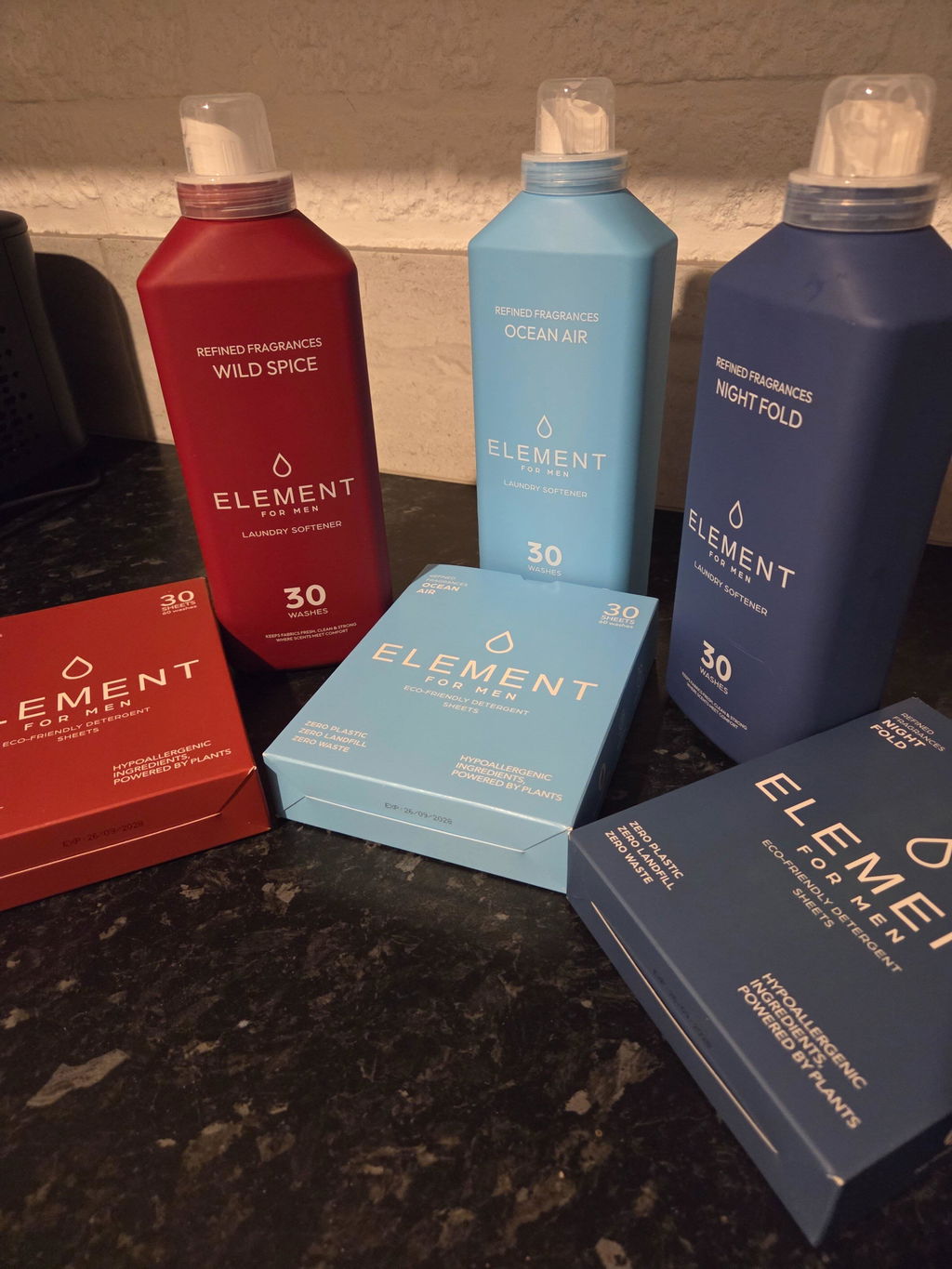
Our conditioners are built the way a fragrance is built rather than the way a cleaning product is: three profiles with a top, a heart and a base, developed to be noticed on fabric at the end of the day rather than at the machine door. 1L bottles, dosed for 30+ washes.
Built on base notes
Three signatures. 1L each.
Quieter in the bottle than a supermarket conditioner. Still there on the collar at 5pm, which is the only test that counts.
 Night FoldLemon, lavender, clean musk, patchouli. The most base-heavy of the three.Fabric softener · £7.99
 Ocean AirAiry freshness, sandalwood, vanilla, warm amber. Soft and everyday.Fabric softener · £7.99
 Wild SpiceBergamot, pepper, patchouli, warm amber. Warm and distinct.Fabric softener · £7.99
All three in one box: The Discovery Softener Kit, £19.99. The matching detergent sheets exist in the same three scents for exactly the layering reason above — bundles pair them from £14.99, and The Wardrobe holds the lot.
If you are unsure which suits you, the ten-second scent quiz is the fastest way through it. If you are switching the detergent half too, the men's detergent range and the honest guide to UK detergent sheets both start there.
Related reading: best smelling laundry detergent, judged properly · how long clothes stay smelling fresh · what eau de toilette teaches you about laundry.